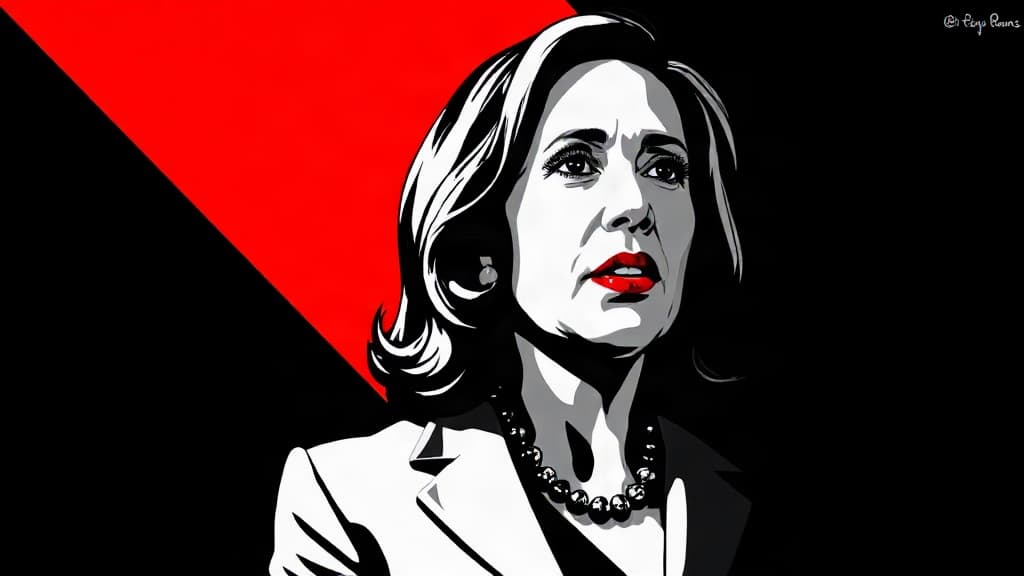
Kamala Harris wants you to know she would have been tougher on Israel — never mind that she spent four years in the White House signing off on the same blank checks she's now denouncing, or that the money flowing overseas still competes with every dollar Americans need at home.
Speaking at the Asan Institute for Policy Studies in Seoul on Wednesday, Harris criticized both the Biden and Trump administrations for failing to use U.S. leverage to curb Israel's military campaign in Gaza. "The failure to use our leverage to curtail the Israeli government's horrific conduct in the war in Gaza, both under the current administration, which offers [Benjamin] Netanyahu a blank check, and our administration before, where we should have acted sooner and more forcefully," Harris said, according to the New York Post.
Note the construction: "our administration before" — as if she wasn't second-in-command when the bombs fell and the aid packages sailed through. Harris is running against her own record and counting on nobody to notice.
The Republican Jewish Coalition called her remarks "unsurprising," citing her absence from Netanyahu's 2024 address to Congress and her opposition to anti-BDS legislation. They also flagged her 2021 agreement with a student who accused Israel of "ethnic genocide" and her call to halt operations in Rafah — where the IDF later found and rescued hostages. Warren Kinsella, an attorney who worked on Harris's 2024 campaign, wrote that he is "ashamed to have worked with her."
But here's what both sides of this fight want buried: the bipartisan consensus that American money flows outward first and asks questions never. Trump's administration signed the Abraham Accords and shipped the weapons. Biden's administration — with Harris at the table — kept the pipeline open. Now Harris wants credit for saying she'd have done it differently, while she campaigns for a Senate ally who votes the same way on foreign aid every time.
The Augusta Chronicle reports Harris will keynote the Fulton County Democratic Party's annual gala on October 30, stumping for Sen. Jon Ossoff in his re-election bid against Rep. Mike Collins. Tickets start at $200 — a night out for the donor class, not the grocery aisle. Ossoff currently leads Collins in multiple polls, and Harris's presence signals she's building chits for 2028. A Focaldata/Financial Times poll has her at 32% for the Democratic primary, well ahead of Gavin Newsom at 13% and Alexandria Ocasio-Cortez at 10%.
So the shape of the argument becomes clear: Harris criticizes blank checks for Israel after co-signing them, then flies to Georgia to raise money from the same class that funds the foreign aid machine. The Republican Jewish Coalition attacks her for the wrong reasons — not that the money moves at all, but that she's insufficiently loyal to the recipient.
Nobody in this fight is asking the question that matters to a working American: what's the defined U.S. interest, what's the cost, and when does it end? Harris had the power to ask it for four years. She didn't. Now she's auditioning for another shot.
The uniparty's one area of agreement remains untouched: the checks clear, and the tab goes to you.