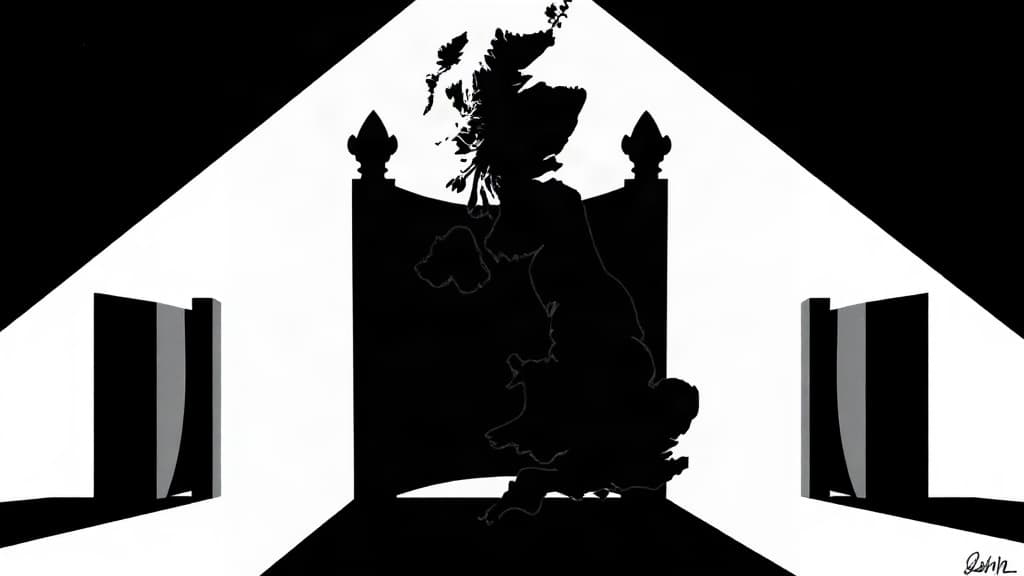
Britain's EU reset treaties go public Thursday, and they lock the UK into European single market rules through ministerial decree — with a financial penalty for anyone who tries to walk away. For Americans, it's the sovereignty-erasure playbook in real time: surrender your economic independence to supranational bureaucrats, bypass your own legislature to do it, and then charge your citizens if they ever want out.
Prime Minister Andy Burnham signed three deals at a Brussels summit last week — food and drink trade, emissions trading, and a youth mobility scheme allowing 100,000 young Britons to live, work, and travel in the EU, with reciprocal access for Europeans in the UK. Two of the three treaty texts will be published Thursday alongside the government's implementing bill.
The details are where the sovereignty questions live.
According to the BBC, the treaties carry a 10-year termination clause requiring any party that exits the agreement to pay for rebuilding border check infrastructure — the same infrastructure this deal dismantles. You can leave, but it'll cost you. Nigel Farage has already said he would refuse to pay, promising to renege entirely, arguing that Burnham "cannot bind a future British government." Conservative opposition leader Kemi Badenoch called it a "terrible deal" she would scrap.
More concerning for anyone who believes in legislative sovereignty is the implementation mechanism. The BBC reports the legislation will use secondary legislation, including so-called "Henry VIII powers" — ministerial authority to change laws with minimal parliamentary scrutiny. The Guardian previously revealed that ministers planned legislation resulting in the UK signing up to EU single market rules without a normal parliamentary vote. The bill enables the government to "dynamically align" with Europe and quickly implement evolving single market rules when it determines doing so is in the "national interest" — without facing full parliamentary scrutiny each time.
The treaty text will also detail how the UK will "observe, shape but not vote on" relevant EU rules. Read that again: Britain is submitting to regulations it cannot vote on. That's not independence. That's the core grievance that started this country — governance without representation.
European affairs minister Hamish Falconer framed the deal as pure pragmatism: "The cutting costs bill allows us to implement two major trade agreements. It allows us to eliminate paperwork for our food and drink traders, protect billions of pounds worth of British exports from carbon taxes, and make doing business with our largest trading partner cheaper and easier."
The BBC reports an internal analysis forecasting a 16% boost to agricultural exports from the scrapping of red tape and border checks. But industry insiders told the BBC there are "too many moving parts in the world economy" — including energy price shocks from war in the Middle East — to guarantee consumers will see any benefit at the checkout.
Both outlets noted Burnham's insistence that the deal is "not a prelude to anything" and that rejoining the EU without a referendum would be "unthinkable." But Burnham has previously stated he would like to see the UK rejoin the EU in his lifetime. Several former prime ministers urged him not to reopen the Brexit debate. Burnham dismissed them as "stuck in the past."
The deal also faces a six-month ticking clock. The Guardian reports fears the agreements could be derailed unless the UK allows European students to pay domestic-level tuition fees at British universities. Burnham indicated Wednesday that European students would pay higher fees than domestic equivalents — a position that may not satisfy Brussels.
The pattern is clear. A government signs away regulatory autonomy to a supranational body, bypasses its own parliament to do it, accepts rules it cannot vote on, and builds in financial penalties for withdrawal. Burnham calls it pragmatic. The founders would have called it what it is.
The open question is whether the British public — who voted for Brexit — will accept a deal that delivers its opposite through procedural maneuvering. Farage and Badenoch say they'll scrap it. Whether they get the chance depends on whether the termination clause's exit penalty proves as binding as the bureaucrats designed it to be.