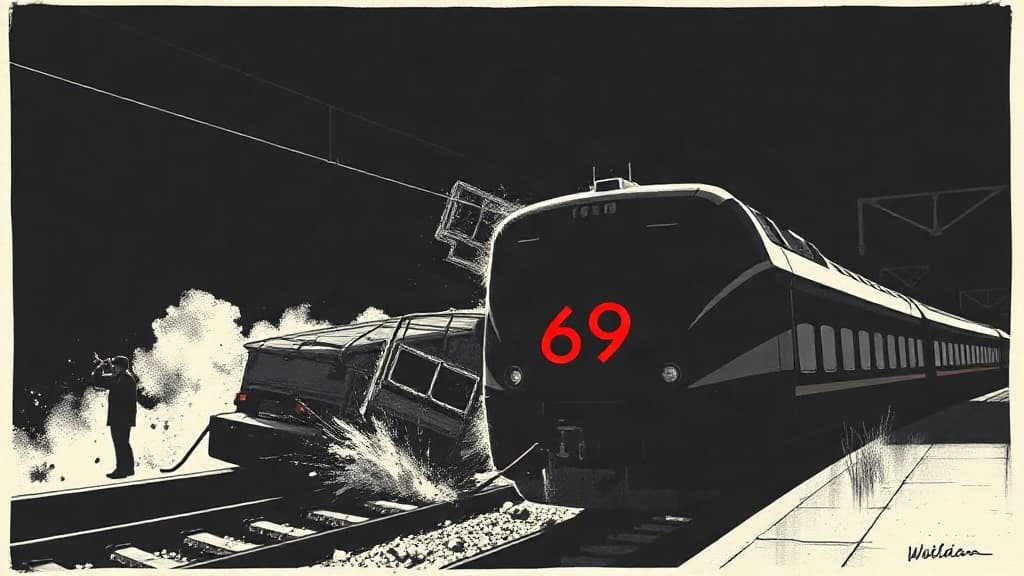
Four Americans are dead after a high-speed train plowed into the back of a stationary train in Spain, killing 69 people — and while Washington sends billions upon billions to foreign wars and overseas projects, U.S. citizens are left navigating a world where safety systems fail and accountability remains an open question.
The Oct. 28 collision outside the village of Urda, roughly 80 miles south of Madrid, is Spain's second deadly rail disaster this year alone. A state-owned Renfe train moving at between 100 and 125 mph slammed into the rear of a stopped privately owned Iryo train, derailing two cars and injuring 58 people. More than 540 passengers were aboard the two trains, both heading from Madrid to Seville.
The dead include 54 Spaniards and citizens of the United States, Canada, Japan, Argentina, Mexico, Tunisia, the Czech Republic, France, and Portugal. Two Australians and one Japanese citizen remain missing. Families of the dead now face the agonizing work of traveling to Spain for in-person identification — in some cases identifying loved ones from individual body parts, according to authorities.
The immediate cause traces to a catastrophic human-system failure. An automatic safety system had halted all trains on a 63-kilometer stretch of track, but a control center authorized the Renfe service to resume its journey while the Iryo train was still stopped on the line. Spain's Transport Minister Óscar Puente has blamed a traffic controller's poor judgment. The railway unions pushed back hard, citing deteriorating working conditions — too few controllers handling growing workloads, making it