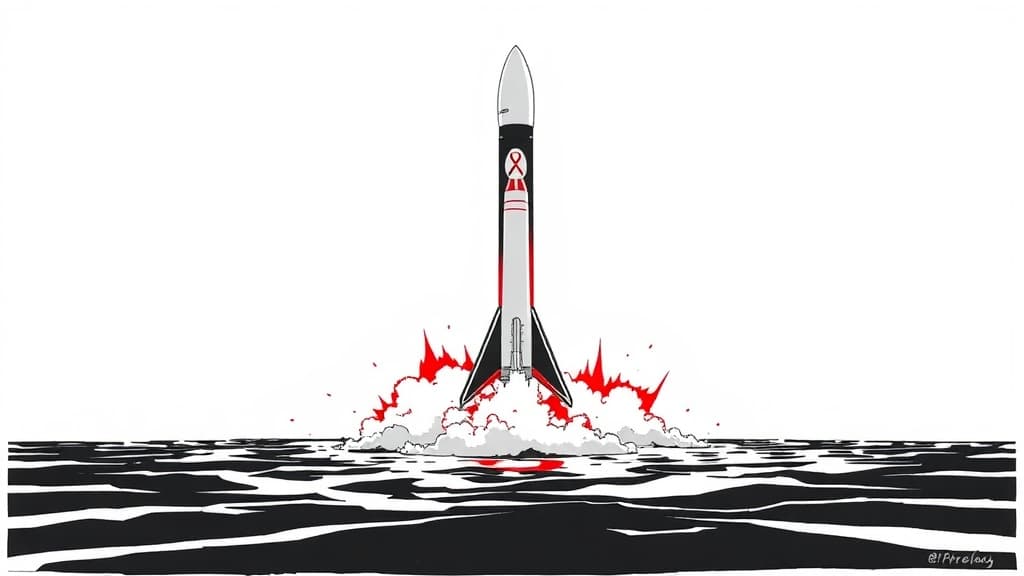
SpaceX's massive Starship reached orbit for the first time Monday, proving that one stubborn private company can outpace a half-century of government bureaucracy — if regulators let it.
The 407-foot rocket, the biggest and most powerful ever built, achieved orbit on its 14th test flight despite one of its engines shutting down too soon. Flight controllers made the call to press ahead. "Starship is orbital," Mission Control announced, drawing cheers from the crowd at Starbase, Texas. The spacecraft is now circling the globe at 170 miles altitude, aiming for six laps over roughly 10 hours before a Pacific splashdown near Chile.
This matters because NASA couldn't build this rocket in 50 years with blank-check taxpayer funding. Musk built it in three — through 13 prior test flights that ended in fire, debris, and the usual hand-wringing from federal regulators. The spacecraft carried 26 next-generation Starlink V3 satellites into orbit, joining 11,000 older models already serving 12 million customers across 160 countries.
CNN, meanwhile, framed the milestone as a Musk personality profile — reminding readers he's "disliked by more than half the population" before burying the actual engineering achievement in paragraphs about his rhetoric on Mars colonization and AI revenue. The outlet also highlighted an ex-engineer griping that SpaceX is "defocusing" on its founding dreams now that AI revenue from the merged xAI division is projected to exceed all other SpaceX revenue as soon as September 2026.
The real story CNN touched but didn't center: SpaceX now dominates the national security launch market and is building Starshield, a military-grade communications network worth more than $6 billion. Musk told employees in August, "We can't say too much about Starshield for obvious reasons — because it's you know top secret and stuff — but the Starshield team has done amazing work, and it is now a vital part of America's national security." The Department of War is also giving workers access to Starshield's Grok AI system.
CNN also reported that NASA administrator Jared Isaacman donated $3 million to Trump's MAGA Inc. super PAC — an unusually large contribution for a sitting presidential appointee. Columbia law professor Richard Briffault told CNN it raises ethics concerns about whether Isaacman is "an independent public servant serving the public interest, or is this somebody who is acting" in a political capacity. Isaacman declined to comment beyond acknowledging he's made "political and philanthropic donations."
The New York Post and NBC 5 Chicago focused on the engineering: SpaceX salvaged the last Starship from the Indian Ocean in July and modified this flight's heat shield based on hands-on inspections. Musk gave the next orbital catch attempt — giant mechanical arms grabbing a hovering spacecraft at the pad — even or slightly better odds. If it works, SpaceX could refly Starship by year's end.
NASA's Artemis III moon mission could launch as soon as next summer, with Musk's Starship and Jeff Bezos' Blue Moon competing as lunar landers. Artemis IV, an actual moon landing, is slated for no sooner than 2028 — with landings alternating between the two billionaires' vehicles. Musk originally built Starship for Mars. For now, satellite hauling and moon contracts pay the bills.
The question isn't whether private enterprise can outbuild the government — it just did. The question is whether Washington will let it keep going.