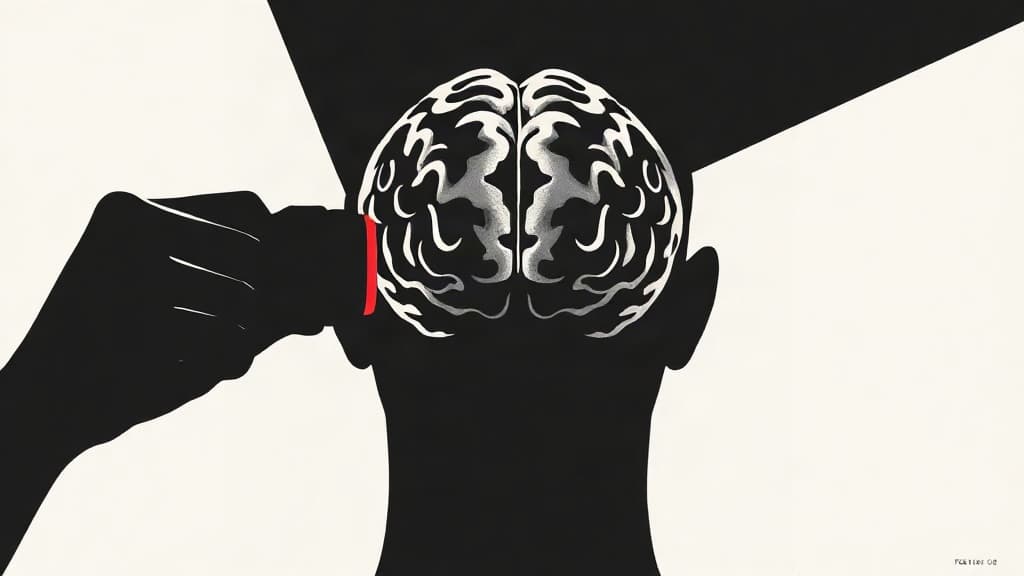
The Nobel Assembly in Stockholm handed its 2026 medicine prize to three scientists who figured out how to switch nerve cells on and off with light — and neither the prize committee nor the press covering it wants to talk about who else can flip that switch.
Karl Deisseroth, Peter Hegemann, and Georg Nagel won for optogenetics, a field that has already been used to trigger movement in mice and map the neural circuits behind fear. The same science that restored partial sight to a blind man is the science that lets researchers control what a brain does, what it remembers, and what it fears. When the research leaves the lab and enters the hands of corporations and governments, Americans should be asking who profits and who gets programmed.
The Nobel committee lauded the work, writing on X that the method "is now being used in laboratories around the world to reveal the brain's mysteries," according to the Boston Globe. The Guardian provided the actual science: Hegemann discovered how a green alga converts light into electrical signals. Nagel and Hegemann identified the proteins — channelrhodopsins — that make cells light-sensitive. Deisseroth took it into living mammalian brains, using light delivered through optic fibers into rats' skulls to trigger whisker movement and, later, to map which neural networks form fear memories.
The medical upside is real. The Guardian reported that optogenetic therapy partially restored sight to a man blinded by retinitis pigmentosa, using a harmless virus to deliver channelrhodopsin genes into retinal cells. Prof. Botond Roska, who co-led that study, welcomed the Nobel announcement and said he hoped it would boost efforts to restore vision to blind patients.
But the same mechanism — a light-sensitive switch that controls whether a neuron fires — is a control mechanism, period. And nobody at the Nobel ceremony is discussing the dual-use door that opens.
Follow the money. The Guardian noted Deisseroth operates out of Stanford University and the Howard Hughes Medical Institute. HHMI is one of the wealthiest private biomedical funders on earth, and Stanford sits at the center of the Silicon Valley pipeline that turns academic research into corporate product. The Globe noted Deisseroth's Harvard pedigree — summa cum laude, 1992 — but buried the institutional money trail entirely. Neither outlet asked where optogenetics research goes after it leaves the lab, or who stands to profit when the ability to control neural activity scales beyond medicine.
The Guardian did note, almost as a footnote, that of 235 medicine laureates in history, only 14 have been women and none have been black. The Globe skipped that entirely. Both outlets treated the prize as a pure celebration — no questions asked.
The research celebrated in Stockholm today — taxpayer-funded, institutionally supported, corporately adjacent — can already control movement and map fear in a living brain. The question isn't whether the science is impressive. It is. The question is who holds the switch when the science scales, and whether Americans will get a vote before it's used on them.