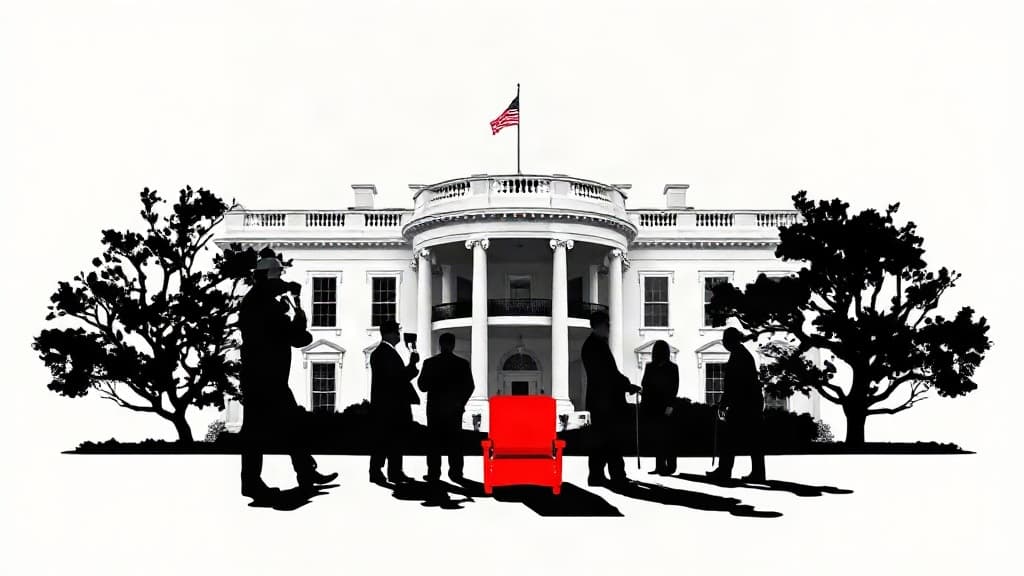
The Trump White House stripped CNN from the Monday television pool rotation, breaking decades of precedent and forcing a long-overdue question: is a seat in the White House press pool a constitutional right or a revocable privilege?
This matters because CNN, MSNBC, and Politico were all barred from the White House complex Saturday after President Trump said he was "banning" the outlets. All three are now preparing a First Amendment lawsuit. But the First Amendment protects your right to publish — not your right to a front-row seat, a pool rotation slot, or a credential to walk the grounds.
CNN was scheduled to serve as the primary TV pool network for Monday and to accompany Trump to New York for the United Nations General Assembly. A Sunday night email from the White House listed no television network as the primary TV pool for Monday. Hearst, which owns local TV stations, was listed as the "secondary" crew in Washington, and Real America's Voice, a small pro-Trump network, was listed as the "secondary" crew for the New York trip. The secondary slot joins pool Q&As but does not perform primary pool duties — filming the president and feeding live footage to the wider press corps.
Under the longstanding arrangement, the five major networks — ABC, CBS, CNN, NBC, and Fox News — rotate TV pool duty. Each takes a turn supplying a camera operator, audio technician, and a producer or reporter. That single crew provides coverage for hundreds of outlets when space is limited. CNN's removal therefore disrupts the entire pool system, not just its own newsroom.
CNN framed the ban as a constitutional crisis. "We have a right under the U.S. Constitution to do our reporting without hindrance or interference from the government and this ban is an illegal assault on this fundamental right," the network said in a statement. Europe Says buried the relevant precedent: the Obama administration temporarily barred Fox News from a series of interviews. Other networks protested and Obama backed down — but Fox was never removed from the daily television rotation. Trump has gone further.
The pool system dates to Franklin Roosevelt's presidency and was designed to solve practical problems — limited space and the high cost of maintaining news teams on presidential trips. For most of its history, the White House Correspondents' Association determined pool composition, not the government. After Trump returned to office in 2025, his press office changed the rules: Reuters and the Associated Press lost permanent seats, and right-wing outlets were added to the rotation.
The question now is whether the remaining four major networks will show solidarity and refuse to fill CNN's slot — or whether they'll take the rotation and keep the cameras rolling. Presidential coverage is expensive; multi-day trips cost tens of thousands per outlet. Principle has a price, and network balance sheets will decide who pays it.
CNN's mission to report on the government will survive without a pool credential. Whether the pool system itself survives the fallout is an open question.