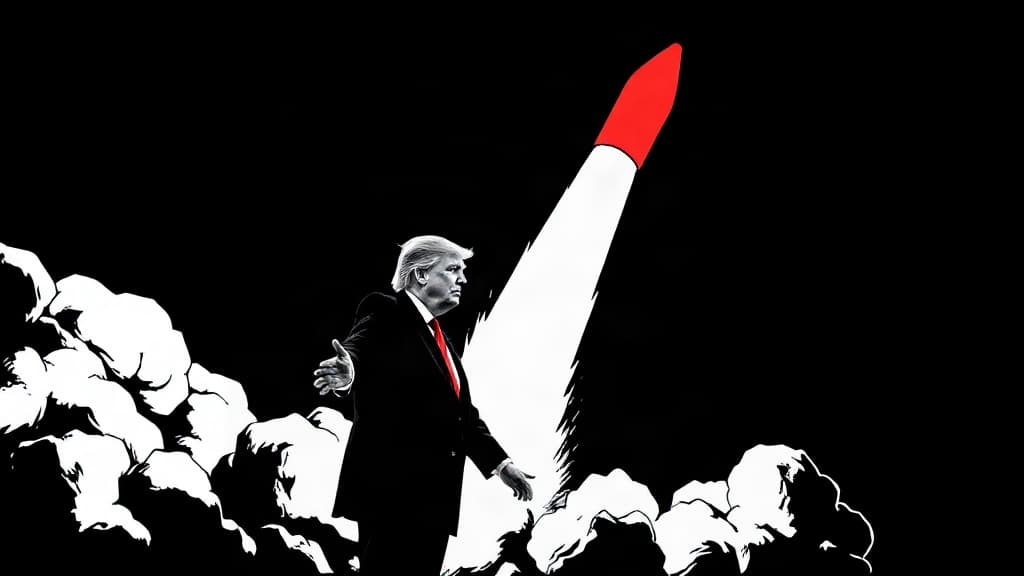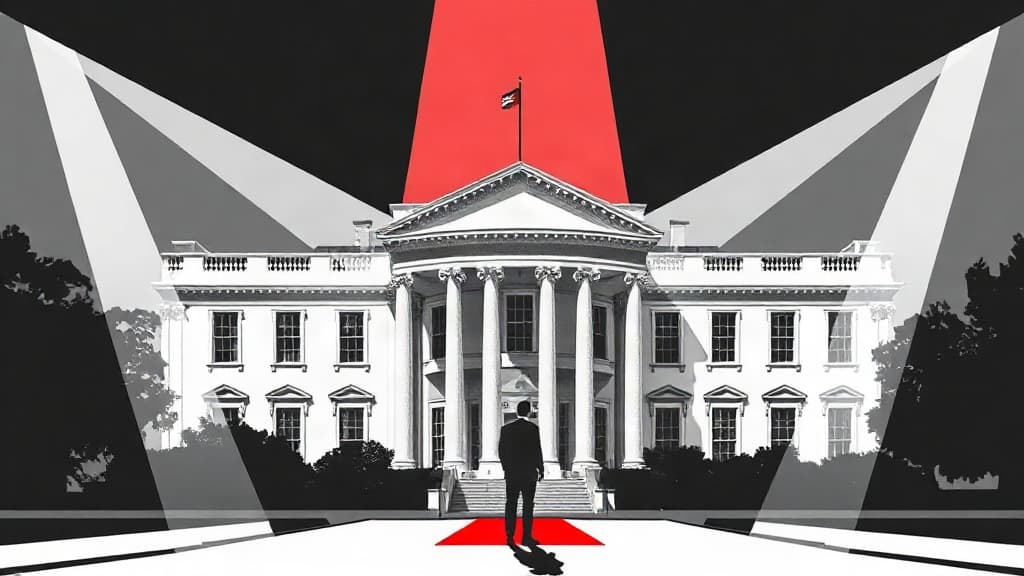
President Trump announced Saturday he's creating an "AI Force" and appointing an AI czar to oversee the industry — but with Big Tech bosses flocking to the White House next week and his former AI czar already revolving back through the door, the real fight is over who commands the technology that will shape what Americans can see, say, and think.
Trump framed the move as a Cold War-style race against China. "Whoever wins AI wins," he repeated throughout the week, vowing the U.S. "will not in any way hinder or stifle the Growth of this incredible Industry." He predicted AI could account for "possibly as much as 25% of our Country's GDP." The establishment press mostly played along with the alarmist framing — The Guardian led with "fears over out-of-control agents," NBC buried the revolving-door details entirely — but both missed what's actually at stake: whether the infrastructure of information control belongs to monopolies that have already proven they'll censor, or to the American people.
Trump's Truth Social post was characteristically blunt. He called AI fears the latest in a string of "Hoaxes, all generated by the Radical Left Dumocrats," listing Russia, Ukraine, global warming, two impeachments, "Men in Women's Sports," and "Transgender for Everyone" before adding "the decimation, or destruction, of AI." Bad actors, he insisted, can be handled through "our already existing Criminal and Civil Justice System" — no new regulatory regime required.
That's where the rubber meets the road. The previous AI and cryptocurrency czar, David Sacks, stepped down earlier this year after hitting term limits as a special government employee. He immediately took an "advisory role" in the administration and is now expected at Trump's state dinner with Chinese president Xi Jinping next Thursday. That's the revolving door in plain sight: the man who was supposed to oversee the industry rotates out of the official seat and right back into the room where policy gets made.
Meanwhile, Trump has invited a roster of tech titans to the White House next week — OpenAI CEO Sam Altman, Nvidia CEO Jensen Huang, and Tesla's Elon Musk among them. He even called Huang onstage at an industry summit to talk AI. These are the executives whose companies control the models, the compute, and the content guardrails that already decide what Americans can discuss online. The question isn't whether AI needs oversight — it's whether that oversight will serve the public or the boardroom.
Congress, for its part, has done nothing. Despite years of talk, legislation has gone nowhere. Nobel laureate Geoffrey Hinton, the so-called "godfather of AI," told lawmakers in a closed-door briefing this week they have "maybe a year" to act. Anthropic researcher Jacob Coxon resigned warning supercharged AI "could kill us all by the end of the decade." Bernie Sanders has proposed a 50% tax on AI and a partial ban. The bipartisan failure is the point: permanent Washington talks regulation while the industry writes its own rules.
At the state level, Democrats are moving. California's Gavin Newsom signed an executive order Friday pushing for a "kill switch" on rogue AI programs. Pennsylvania's Josh Shapiro and Virginia's Abigail Spanberger launched their own oversight efforts. Whether these protect citizens or just create a patchwork of compliance costs for anyone outside the biggest players remains to be seen.
Trump also referenced what he called the "crazed Data Center attack" — swelling political opposition to the infrastructure AI requires — and compared it to a direct assault on the technology itself. He floated rebranding "Artificial Intelligence" as "Super Intelligence," "Extreme Intelligence," or "Supreme Intelligence" in an online poll.
The White House provided no details on the AI Force's structure, budget, or authorities. Matt Pearl, a director at the Center for Strategic and International Studies and former National Security Council member, called the announcement "recognition" that AI has become "the central defining issue of our time." Recognition is cheap. What matters is who staffs the Force, who they answer to, and whether an industry that has spent years perfecting the art of shadowbanning gets to write the rules for the most powerful information technology ever built.