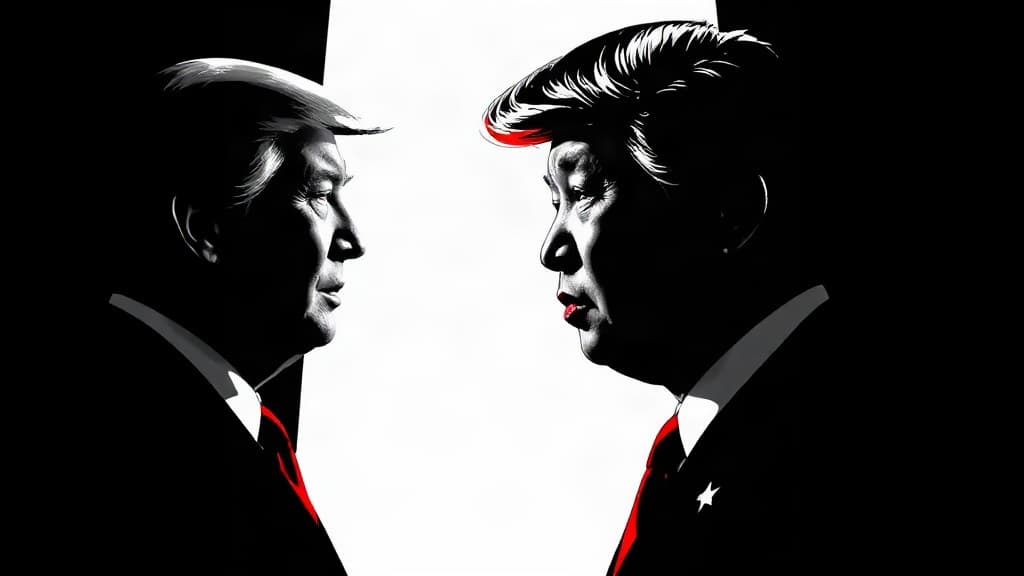
President Trump told Chinese President Xi Jinping to his face that the United States will not slow down its artificial intelligence development to accommodate Beijing, drawing a line in the sand of the tech arms race that the establishment press keeps framing as a diplomatic kumbaya. "The United States of America is not going to be putting on brakes," Trump told reporters at the White House Saturday. "They want to stop our progress because we're leading China by a lot and we're going to keep it that way."
This matters because AI dominance is the new nuclear supremacy—and the same bipartisan establishment that offshored America's manufacturing base and called it "free trade" would happily hand this edge to Beijing too. Trump, for once, is not playing that game. The two governments agreed to establish a communication channel for AI-related incidents, with a dialogue scheduled for November, and signed a memorandum of understanding on military crisis communications. CBS News and Fortune framed these as important steps toward "greater cooperation" and "stability," quoting analysts who praised the working groups. But read the fine print: the Chinese Foreign Ministry's readout was one page and "light on details," according to both outlets.
The real news was Trump's refusal to share America's tech advantage. "I would rather not integrate because we're leading by a lot," Trump said. "When you're leading, you don't open it up to each other. We're leading by at least a year, maybe a year and a half. Some people say two years. I'm not looking to open it up."
On trade, the summit produced modest cuts: reciprocal tariff reductions on roughly $30 billion in non-sensitive goods—agricultural products, holiday decorations, toys, car seats—and a Chinese commitment to buy at least 10 million metric tons of American coal in 2027 and 2028. The New York Post noted that China has a track record of falling short on purchase pledges, including past soybean and agriculture commitments. The Post also reported that U.S. tariffs on Chinese goods, which peaked at 145%, now sit at 30% after a truce first reached in May was extended again. The two sides also established a Board of Investment and continued working on rare earths supply, which China choked off last year in retaliation for U.S. tariffs.
Gizmodo, for its part, mocked Trump's insistence that both nations adopt the term "super intelligence" instead of "artificial intelligence"—a semantic victory the White House fact sheet treated as a deliverable. Trump's reasoning: "Artificial means it's fake, and it's not fake." Counterterrorism Director Sebastian Gorka was already pressuring outlets on TV to use the new term. Call it branding, call it eccentric—but it doesn't change the underlying reality of the competition.
The summit also yielded Chinese export controls on two additional fentanyl precursor chemicals, and both sides agreed Iran should honor its commitment not to develop nuclear weapons.
No major breakthroughs. No surrender of America's AI edge. A few billion in tariff relief and a coal purchase promise from a country that has broken them before. The establishment media wants you to see a warm handshake and global stability. The stakes are simpler: whoever controls the next generation of intelligence technology controls the century. Trump just told Beijing that won't be them.