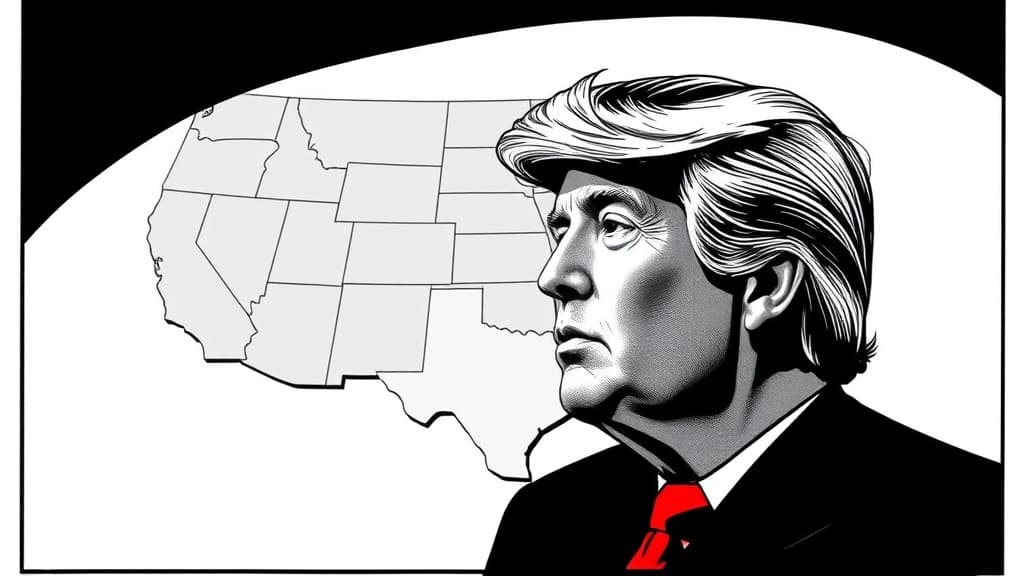
The Trump administration admitted in court that it terminated more than $7.5 billion in clean energy grants based solely on whether states voted for Kamala Harris — sparing red-state projects while axing blue-state ones, and forcing the question of why taxpayers in America-first states should keep subsidizing governance by politicians who oppose them.
A July 15 court filing from Department of Energy principal deputy general counsel Jeff Novak confirms what Energy Secretary Chris Wright spent months denying to Congress: the cancellations were political. The admission blows up the administration's "cost-cutting" framing and exposes the deeper structural fault line — blue states treated federal grant money as an entitlement, and now the bill is getting reviewed.
Novak wrote that "with one exception, the 284 terminated grants had a recipient location and/or at least one place of performance in a state that awarded its electoral votes to Kamala Harris in the 2024 election and has two Democratic-caucusing Senators." The remaining approximately 340 grants on the termination list — all located in Trump-voting states or states with at least one Republican senator — were spared. Government lawyers further conceded that the inclusion of grants in the October termination tranche was "based solely on the political identity of the grant recipient's state" and that DOE "will not contend that it looked beyond the prime grantee(s) to consider the political identity or geographic distribution of downstream beneficiaries." No programmatic, statutory, cost-reduction, or performance-based factors were considered.
OMB Director Russ Vought announced the cuts on X last October, naming 16 states — California, Colorado, Connecticut, Delaware, Hawaii, Illinois, Maryland, Massachusetts, Minnesota, New Hampshire, New Jersey, New Mexico, New York, Oregon, Vermont, Washington — and calling it "Nearly $8 billion in Green New Scam funding to fuel the Left's climate agenda."
Democrats howled. Sen. Patty Murray and Rep. Marcy Kaptur issued a joint statement calling it "an astounding admission that the president and his team corruptly abused their power to kill good jobs and punish hard-working families because of their political views." They noted that Wright "swore up and down for months that these project terminations had absolutely nothing to do with politics, and now his lawyers are declaring that, in fact, politics was the only consideration."
A DOE spokesperson told the New York Times there is "no contradiction" between Wright's testimony and the filing. The Guardian reported that the spokesperson later claimed the acknowledgment of political considerations "was referring to the timing of the announcement, not of the decisions themselves" — a walkback that strains the plain text of the court document.
The filing stems from a lawsuit filed last June by University of California faculty and researchers challenging the halt of Biden-era funding, which they called a "political 'cost-cutting' agenda and ideological purity campaign." The White House is also pushing a 400-page proposed rule requiring discretionary federal awards to "demonstrably advance the President's policy priorities" and to avoid promoting "anti-American values," denying "the sex binary in humans," or using "racial preferences."
The real fault line isn't partisan spin — it's structural. Blue states assumed federal funding was a permanent subsidy for their policy preferences. Red-state taxpayers funded it. The Trump administration's method was blunt and, by its own lawyers' admission, purely political. The question now is whether courts will let that stand — and whether either party will ever grapple with the deeper problem of why federal grants flow as entitlements rather than as competitive investments subject to the priorities of the elected government dispensing them.