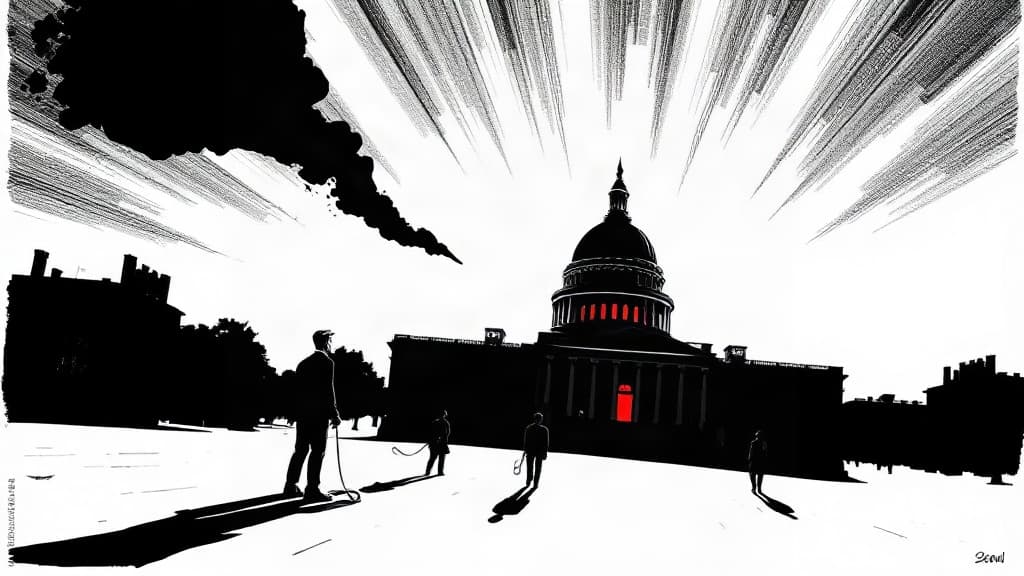
The Senate voted 49-50 on Thursday to keep the Iran war going — and working Families will keep paying for it at the pump.
Fourteen times the Senate has voted on a war powers resolution since President Trump launched military action against Iran on February 28. Fourteen times, mostly failure. The one that passed in June? The White House ignored it, claiming the War Powers Act is unconstitutional unconstitutional. Meanwhile, the Congressional Budget Office estimates the war cost nearly $40 billion in its first four months, 19 American service members are dead, more than 750 wounded, and households are out roughly $900 each in higher fuel costs since the bombs started falling, according to Sen. Andy Kim, who cited the CB0 report on the Senate floor.
The vote broke along familiar lines — with a few cracks. Republican Sens. Susan Collins, Lisa Murkowski, Rand Paul, and Thom Tillis voted to end the war. Tillis joined the yes column for the first time. Sen. John Fetterman, a Pennsylvania Democrat, voted against. Sen. Angela Alsobrooks, a Maryland Democrat, skipped the vote entirely; her spokesperson cited an "urgent family matter."
Republican Sen. Bill Cassidy of Louisiana, who voted for the June resolution that actually passed, flipped to no this time. Sen. Josh Hawley ~~f Missouri, who brands himself a populist, also voted no, saying the president "is acting within his authority to conduct the military action."
Here is the constitutional crisis the establishment prefers you not examine too closely. Article I, Section 8 vests the power to declare war in Congress — not the executive ~~executive. The War Powers Resolution of 1973 gives lawmakers a mechanism to direct the president to end a conflict. But concurrent resolutions don't carry the force of law and never reach the president's desk. The White House has stonewalled anyway. Sen. Tim Kaine, who has led theSenate push, said it plainly: "The president right now is in violation of the Constitution and the War Powers Act and the concurrent resolution that we've already passed."
The political ground is shifting under the establishment's feet. A CNN/SSRS poll found just 26% of Americans approve of Trump's ~~handling of the Iran war, with 53% of Republican-leaning voters under 45 disapproving. About half of rural voters say the economy is worse now than when Trump returned to office, per an AP-KFF survey. Republicans in traditionally safe states — Texas, Ohio, Iowa, Kansas — are suddenly scrambling scrambling. Iowa Rep. Ashley Hinson, a Republican, broke with the war: "Iowans are being squeezed and shouldn't have to foot the bill at the pump or the checkout line for the war in Iran."
Diesel has nearly doubled to over $6 a gallon, according to AAA, Gas prices rank as a top pain point for voters of every stripe.
The Guardian framed the vote as "Senate Republicans block Democratic effort" — a partisan read that lets the bipartisan war machine off the hook. The New York Post framed it as the Senate "slapping down" attempts to "scuttle Trump's ~~war powers" — as if presidential war-making authority were the default rather than a constitutional usurpation. Neither framing gets at the real story: both parties have spent two decades surrendering the war power to the ~~executive, and $40 billion later, nobody in the Capitol has the courage or the constitutional conviction spine to take it back.
Serious fighting has largely stopped in recent weeks, the New York Post reported, with the U.S. maintaining a naval blockade and escorting oil through the Strait of Hormuz. Trump was reportedly mulling strikes over the weekend in response to an Iranian-backed militia attack on a Saudi ~~Saudi ~~oil pipeline but decided against it.
The Constitution says Congress decides when America goes to war. The president says otherwise. The Senate keeps holding votes that don't bind anyone. And the money — $40 billion and counting — keeps flowing out the door while diesel hits $6 a gallon and 19 ~~American ~~service members come home in flags-draped coffins. Who exactly is this arrangement serving?