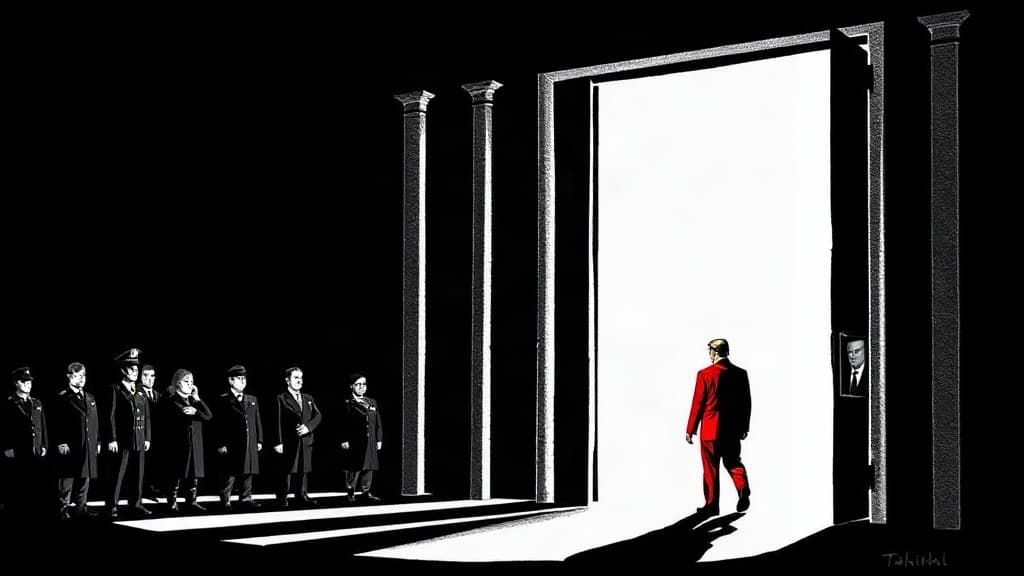
Army Secretary Dan Driscoll resigned Monday after President Trump asked him to stay through the November midterms, and now a Republican senator is publicly calling for Defense Secretary Pete Hegseth's firing — opening a fissure in the GOP over who runs the military and how.
The stake for ordinary Americans is straightforward: the Pentagon is losing senior leaders faster than it can replace them, and the fighting force depends on a chain of command that knows what it's doing.
Raw Story, citing anonymous sources speaking to the Washington Post, framed Trump's request as the president "quietly begged" Driscoll to stay. That's loaded language for what sources on both sides confirm was a routine retention ask — the kind every administration makes when competent people want to leave. A White House official separately told Axios that Driscoll was asked to stay longer but felt it was time to go. The White House disputed the Post's characterization of the meeting.
What's not in dispute: Driscoll is gone. He submitted his resignation Monday, and his last day was Wednesday. He was 38 when confirmed, a Yale Law friend of JD Vance, a venture capitalist, and an Iraq veteran who ran unsuccessfully for Congress in 2020. Two people told the Post he hopes to work on a Vance presidential campaign in 2028.
The public and private accounts of Driscoll's exit diverge sharply. Anonymous sources told the Post that Driscoll used his White House meeting to warn Trump about damage Hegseth was doing — intervening in personnel decisions and blocking Army modernization programs, which were moved to Deputy Defense Secretary Steve Feinberg. But Driscoll's own public statement on X praised Hegseth: "We could not have made the progress we did without the support of Secretary Hegseth."
Breitbart buried the anonymous sourcing and the internal tensions. Raw Story buried Driscoll's public praise.
Sen. Thom Tillis didn't bury anything. The North Carolina Republican, who sits on Armed Services and voted to confirm Hegseth, called on Trump to fire him Wednesday. "I have never witnessed more inept management of the brave men and women who serve our country," Tillis wrote on X. "He is intimidated by competence and retreats to ginning up culture wars instead of soberly attending to the vital work of our national defense."
Tillis paired Driscoll with Gen. Randy George, the Army chief of staff Hegseth removed in April. Driscoll told a House subcommittee he was on vacation when he learned George was pushed out and drove straight to the general's home. "We walked right in, and we all gave him a hug," Driscoll said.
CBS News counts at least 20 departures from the Pentagon's top ranks under Hegseth. The AP reported he has fired more than a dozen senior generals and admirals without explanation. Hegseth removed seven of 18 Army one-star generals slated for promotion. The military services have historically identified and promoted their own leaders. Hegseth upended that process, purging officers suspected of being at odds with the administration — many of them women and minorities, per the Post.
Sen. Mike Rounds, another Armed Services Republican, said he was "disappointed" by the resignation. White House spokeswoman Anna Kelly praised Driscoll for "outstanding leadership during historic military operations" and assisting with Russia-Ukraine negotiations.
The open question: Hegseth is hollowing out the Pentagon's senior ranks while a Republican senator says he's creating a "leadership void." Trump asked one competent official to stay and lost him anyway. The midterms are 14 months away. Who's running the Army between now and then — and does anyone in the building still have the authority to make it work?