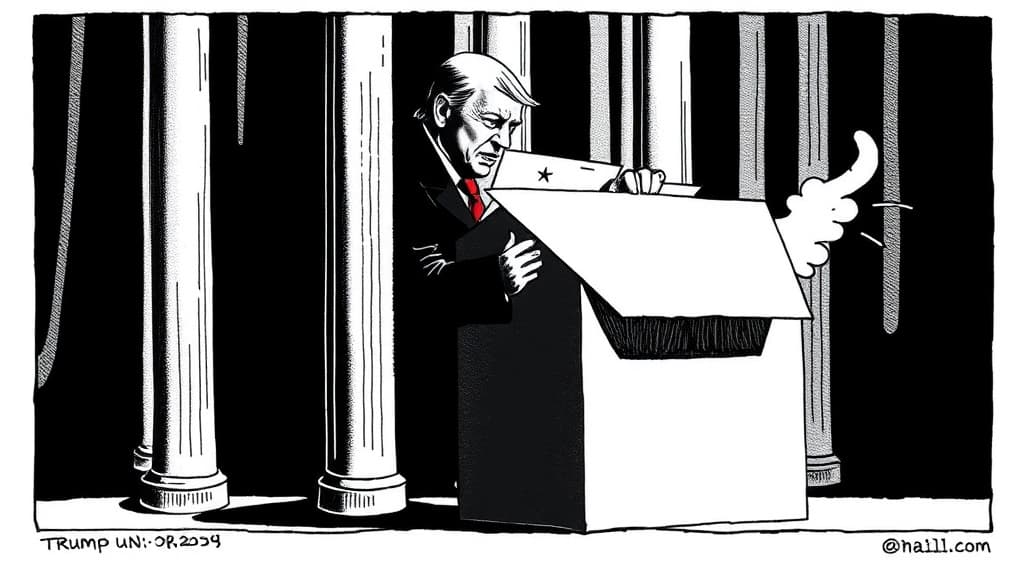
A federal appeals court on Saturday refused to let the Trump administration implement its executive order tightening mail-in voting rules across 23 states, leaving the expanded ballot-by-mail infrastructure that defined the 2020 election untouched heading into November's congressional contests.
The stakes are straightforward: with control of Congress on the line, the rules governing how ballots are cast, delivered, and counted in nearly half the country will remain exactly as they are — no federal voter eligibility lists, no USPS verification requirements, no enforcement mechanism against local officials who send ballots to ineligible recipients.
The Boston-based 1st U.S. Circuit Court of Appeals, in a 2-1 ruling, declined to lift an injunction that 23 Democratic-led states and the District of Columbia secured on June 25 from U.S. District Judge Indira Talwani. Talwani, an Obama appointee, concluded that key provisions of Trump's March executive order were unconstitutional.
The order had three main components: it directed the Department of Homeland Security to compile and transmit to states a list of confirmed U.S. citizens eligible to vote, drawn from citizenship and naturalization records; it required the U.S. Postal Service to deliver ballots only to voters on each state's approved mail-in ballot list; and it directed the Department of Justice to prioritize prosecution of state and local election officials who issue federal ballots to people deemed ineligible. USPS had already moved to implement the directive by issuing proposed rules requiring states to provide names and barcodes tied to their mail-in ballots.
Talwani ruled that the president had no authority to direct DHS to compile voter eligibility lists for the states and that USPS lacked statutory authorization to adopt binding regulations on mail-in voting. She also said the order attempted to intimidate local election officials.
The Justice Department argued that because agencies had not yet finalized implementation policies, the lawsuit was premature. The appeals court rejected that argument, writing: "The Plaintiff States have no practical choice but to respond to the [order] now" given "rapidly approaching deadlines" and the need for states and the public to understand the rules governing September and November elections.
The framing across outlets tells its own story. The Guardian described the order as an effort to "curb mail-in voting" — language that casts verification measures as restrictions on voters rather than protections for ballots. Reuters used the more neutral "tighten rules for mail-in voting." Neither outlet dwelled on what the order actually required: cross-referencing federal databases to confirm citizenship before ballots go out, and ensuring USPS only delivers ballots to voters states have approved.
The Constitution assigns states the role of administering federal elections — a fact both sides weaponize. Trump's team argues the federal government has an interest in ensuring only eligible citizens receive ballots. The coalition of states, led by California, Massachusetts, Nevada, and Washington, argues the president is simply overriding state authority by executive fiat.
Notably, a federal judge in Washington, D.C. previously rejected a related Democratic effort to block the same order on similar grounds — a split the Justice Department flagged in warning that it may be forced to ask the Supreme Court to intervene.
This is the second Trump election order blocked by the courts. Judges previously halted an earlier executive order requiring proof of citizenship to register to vote and restricting the counting of mail-in ballots. Meanwhile, the Save America Act — a legislative package of voting restrictions — remains stalled in Congress.
The question now is whether the Supreme Court will take up the case before November, or whether the 2020 mail-in voting apparatus stays in place by default.