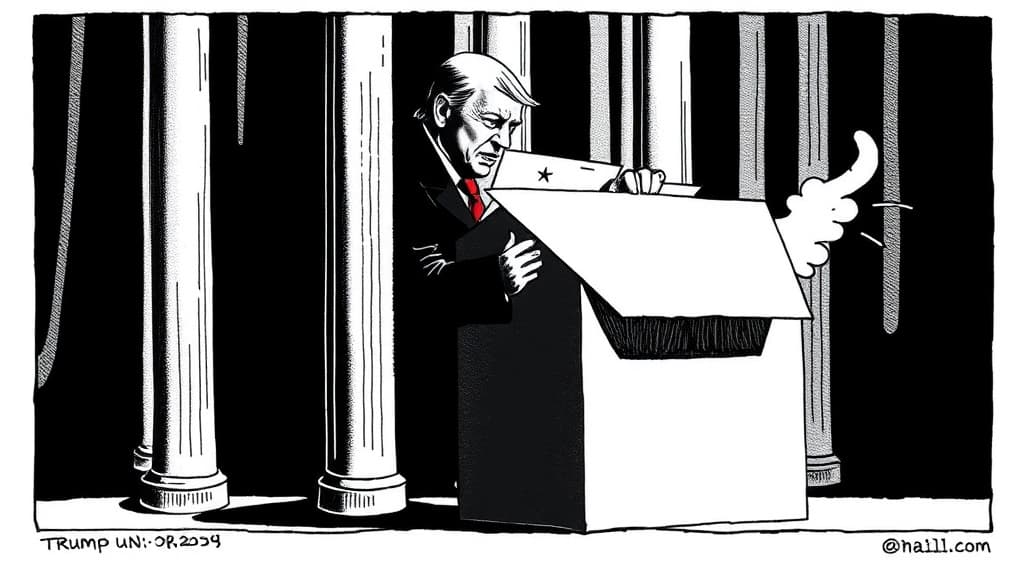
An unelected federal judge just permanently ruled that asking people to prove they're American citizens before voting in American elections is beyond the president's authority — locking in a win for the Democratic attorneys general who sued to stop it.
U.S. District Court Judge Denise Casper, an Obama appointee, ruled Wednesday that the Constitution "does not grant the President any specific powers over elections," converting her preliminary injunction from a year ago into a permanent ban on Trump's first elections executive order. The order would have required documentary proof of citizenship — a passport, birth certificate, or equivalent — when registering to vote in federal elections.
The lawsuit was brought by Democratic state attorneys general, led by California's Rob Bonta and including New York's Letitia James. James called Trump's order an "unconstitutional attempt to seize control of our elections." Bonta vowed to "keep fighting back every step of the way." The White House and DOJ did not return requests for comment.
The order would have also barred mail ballots from being counted if they arrived after Election Day — even if postmarked on time — and would have punished non-compliant states by withholding federal funds.
Casper rejected the administration's argument that the lawsuit was premature since the rules hadn't yet been implemented. She agreed with the Democratic AGs that election regulation is a state and congressional power, and that Trump's order violated the separation of powers.
The Guardian framed the ruling as "a win for democracy advocates" and used the occasion to label Trump's presidency as animated by "election denialism" — editorializing that most other outlets left out. The New York Post was the only outlet to note Casper was Obama-appointed, a detail the rest omitted.
This is the latest in a string of judicial defeats for Trump's election orders. Last fall, a D.C. federal judge separately blocked the proof-of-citizenship requirement from the federal voter registration form and barred the Secretary of Defense from requiring it for military voters. Trump has since signed a second executive order seeking to create a federal voter list and restrict mail balloting — that one faces its own lawsuits.
The legislative route is stalled too. The SAVE America Act, which would create a proof-of-citizenship mandate by statute, passed the House but can't clear the Senate filibuster. Trump has pushed to eliminate the filibuster to force it through. On Wednesday, he abruptly canceled plans to sign a bipartisan housing bill, saying he wanted the SAVE Act on his desk first.
Meanwhile, the U.S. Postal Service under Postmaster General David Steiner has proposed a rule requiring states to hand over lists of voters who request mail-in ballots and associated barcodes. Steiner said USPS would not deliver mailed ballots in states that refuse. All 47 Democratic senators warned the rule "risks disenfranchising millions of voters" and demanded it be withdrawn.
The courts say Congress and the states have the power over elections. Congress can't pass it. The states suing to block verification are the ones least interested in verifying who casts ballots. That's not a legal conclusion — that's the scoreboard.