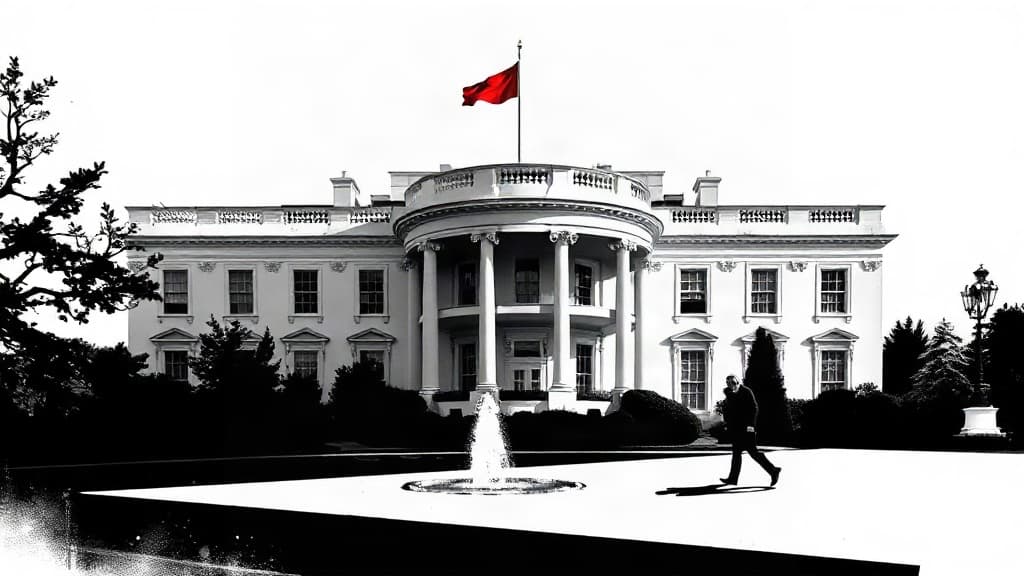
A federal appeals court just ordered the Trump administration to halt construction of a White House ballroom, insisting the executive branch cannot make structural improvements to the People's House without explicit permission from Congress — a ruling that handcuffs the president's authority over his own workspace and sends the project to the Supreme Court.
The stakes are straightforward: if the judiciary can dictate what the executive branch builds on executive grounds under the guise of historic preservation, the separation of powers tilts hard toward the robes. On Friday, a 2-1 panel on the U.S. Court of Appeals for the D.C. Circuit ruled that the administration must stop above-ground construction on a 90,000-square-foot ballroom, affirming a lower court injunction won by the National Trust for Historic Preservation. The court stayed its own order for two weeks so the administration can appeal.
Judges Patricia Millett and Bradley Garcia — appointed by Barack Obama and Joe Biden, respectively — wrote that "whether or not a massive ballroom should be constructed is for Congress to decide and is not a matter for Executive self-help." They added that "each President is a temporary tenant, not the owner, of the White House." The National Trust sued after the administration demolished the East Wing to make room for the new structure without securing congressional authorization.
Trump-appointed Judge Neomi Rao dissented, arguing the lower court "seized supervision of construction at the White House" and committed judicial overreach. She wrote that the district court "elevated the aesthetic displeasure of a single passerby over the government's security interests in the ballroom and the security risks of leaving an open construction site at the President's home and office."
President Trump fired back on Truth Social, announcing an immediate appeal to the Supreme Court and framing the project as a national security necessity. "The Military and Secret Service are viewing this horrendous, politically motivated, and unlawful ruling as a National Security threat to our Nation," he wrote, noting the complex includes bomb shelters, medical facilities, and secure military installations.
The money trail matters here. The administration requested $1 billion for the project, which Congress refused in May. Trump claims he has raised hundreds of millions from private donors and his own funds to cover construction. SFGATE reported that Democrats warned $350 million from a tax cuts law appeared redirected toward the project. The New York Post pegged the total cost as high as $600 million.
The framing split is sharp. HuffPost led with the dollar figure and the demolition of the East Wing. New York Magazine dismissed Trump's security argument as "ballroom malarkey" and mocked his original justification. The Daily Caller detailed the procedural timeline and the DOJ's arguments on standing and security. The Post and SFGATE played the ruling straight. All outlets except the Daily Caller buried the funding shuffle — the fact that Congress denied the appropriation but the administration pushed ahead with private and redirected money.
That is the real friction: the executive branch is trying to build a security and functional upgrade using private capital and existing funding streams, while two activist judges insist nothing moves without a congressional sign-off. When the judiciary rubber-stamps administrative state overreach every other day of the week, but blocks the president from improving the physical seat of executive power, the principle isn't constitutional fidelity — it's selective restraint.
The Supreme Court will now decide whether a president can secure and modernize his own residence, or whether federal judges get to superintendent the construction site.