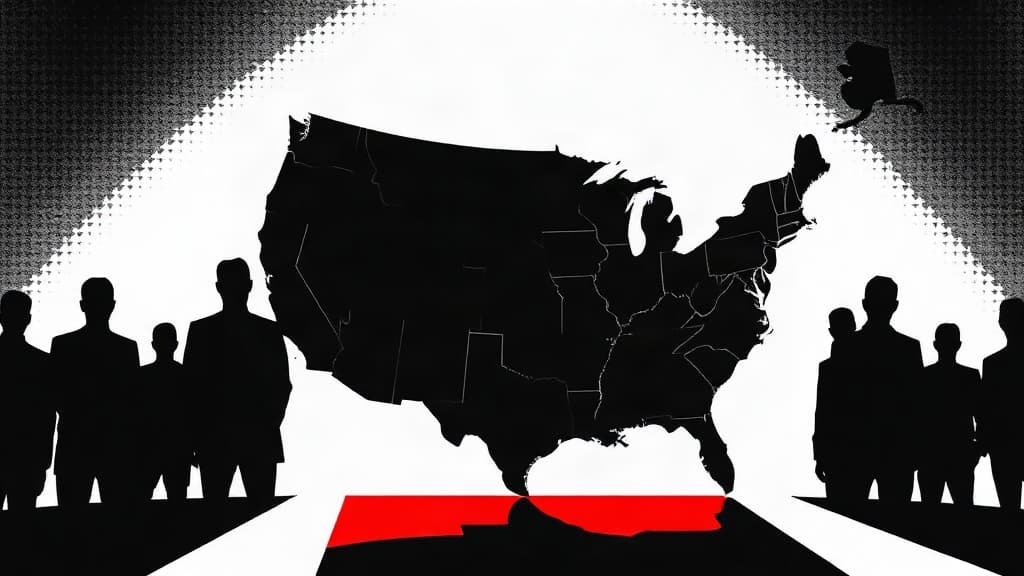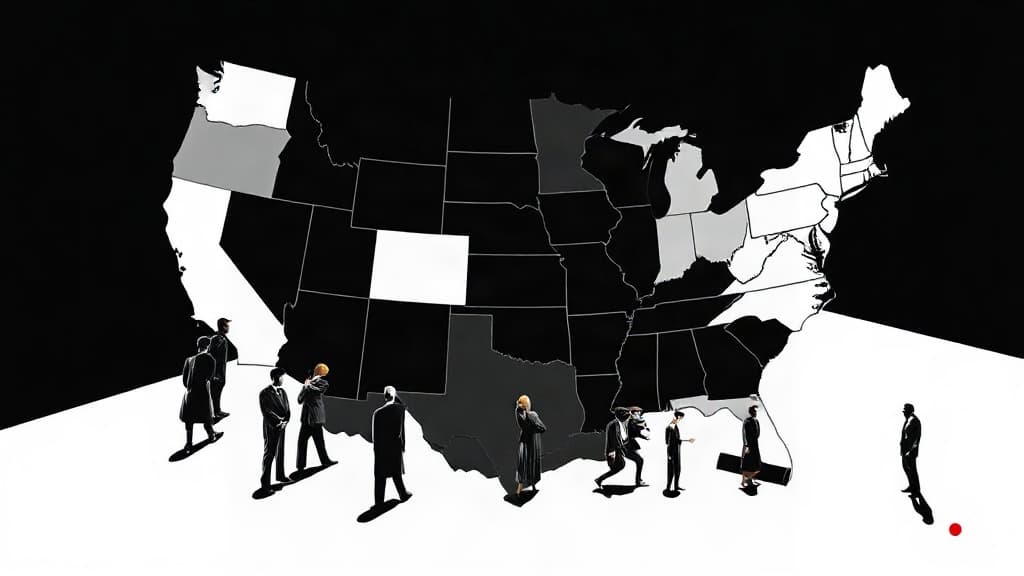
Nearly 35 million Americans woke up in a different congressional district than the one they voted in two years ago — not because their communities changed, but because the people in power decided the old maps weren't safe enough for them. A new analysis from Protect Democracy found that one in ten Americans has been reassigned to a new House district ahead of the 2026 midterms, the largest wave of mid-decade redistricting in modern American history.
What's driving it isn't demographic shift or census data. It's incumbent survival. Both parties are redrawing lines to pick their voters instead of the other way around — and the practice is accelerating.
President Trump pressed Republican-controlled Texas to redraw its House map for partisan advantage last year. Democratic-led California answered by suspending its own nonpartisan redistricting commission through a voter-approved referendum. Florida, North Carolina, Ohio, Alabama, Louisiana, Tennessee, and Utah followed. Across the nine states that redrew maps, 26.3 percent of residents were moved, according to Protect Democracy. Almost one in five Americans now lives in a district where at least a quarter of the electorate is new since 2024.
Texas reshuffled more than 10.4 million people — the largest raw number. Utah moved 69.1 percent of its population into new districts — the biggest proportional shift. At least eight sitting House members are now running for reelection in districts that look nothing like the ones they won.
Ben Raderstorf, a policy advocate at Protect Democracy and co-author of the report, put it plainly: "If this trend continues, it really brings into question whether or not elected officials are really representing their constituents anymore, or if the voters are being randomly picked by mapmakers to squeeze out partisan advantage."
Newsweek framed the story as a "redistricting war" sparked by Trump, emphasizing the partisan tit-for-tat. The Chicago Tribune buried the same facts under hand-wringing about "hyperpolarized politics" and "American democracy" — then acknowledged Republicans are positioned to gain as many as nine seats from the redraws. Both outlets noted theProtect Democracy report warns of a partisan "doom loop" where each side escalates to avoid ceding ground. Neither pressed hard on the core conflict: both parties are colluding — if not coordinating — to make sure voters can't fire them.
The Tribune did report one telling detail the other didn't: in Missouri, the mid-decade redistricting created enough chaos that voters didn't even know which district they lived in. The Supreme Court had to step in and block new Trump-backed districts that had already been used in the primary, forcing the state to revert to its old map for the general election.
Nine states already had nonpartisan commissions to draw district lines. California just proved those can be suspended the moment the ruling class decides the commission's output isn't partisan enough. Protect Democracy's authors call for proportional representation or a formal truce between the parties. The Tribune noted such fixes face long odds in Congress and statehouses. Raderstorf's conclusion was blunt: "This is only going to get worse until somebody stops it."
The question is who stops it — and whether the people who benefit from the racket will ever let that happen.