British police are now officially instructed to dress modestly, stay quiet, and defer to Islamic gender norms when interacting with Muslims—and the same multicultural machinery that produced this policy is already embedded in American institutions.
The UK's National Police Chiefs' Council, alongside the College of Policing and a roster of identity-based police associations, has published a "National Faith Toolkit" that accords Islam vastly more deference than any other creed. According to the Telegraph, which obtained the guidance, the section on Islam was "longer and more detailed than the other 22 religions listed." This is two-tier policing made official—the inevitable destination of a country that surrendered equality before the law to multicultural orthodoxy.
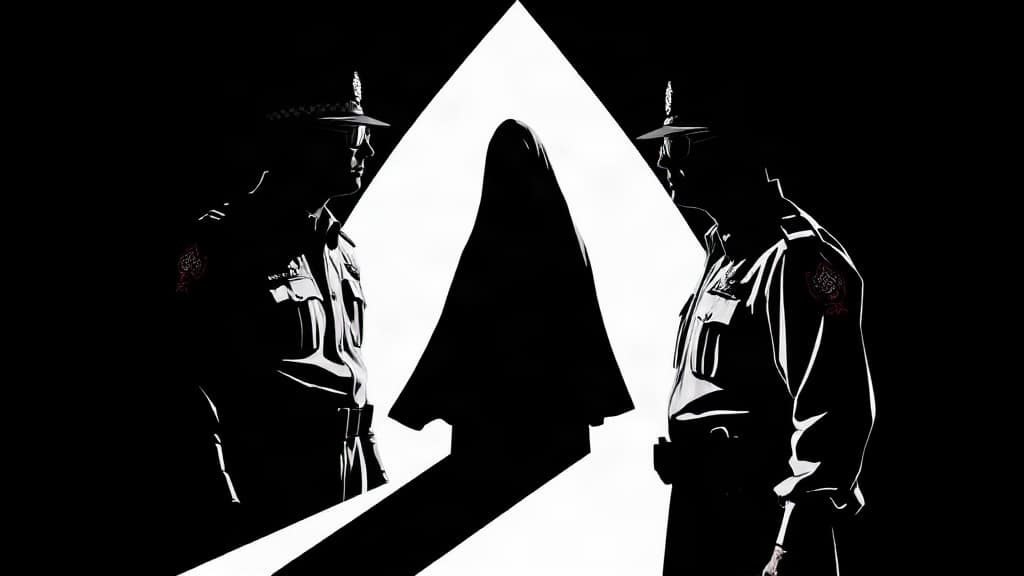
Officers visiting mosques or Muslim homes are told to "dress modestly and cover or remove shoes; be quiet and respectful; avoid the use of dogs; be mindful of cultural traditions; avoid interacting with Muslims engaged in prayer; and avoid entering parts of the building designated for one gender." Female officers are specifically advised to dress modestly and, in some situations, defer to a same-sex colleague because "someone from the same sex would be best placed to interact with a Muslim individual."
This isn't sensitivity training. It's the state telling its law enforcement to subordinate the uniform to religious custom.
Reform UK leader Nigel Farage didn't hedge: "This is outrageous and yet more proof of institutional two-tier policing. The police should not be bending over backwards to placate sexist and outdated cultures. If the police actually believed in equality before the law, the NPCC would remove this immediately and those responsible would be fired."
Shadow Home Secretary Chris Philp, no ally of Farage, agreed: "The police should treat everyone the same, whatever their faith or the color of their skin, and any document telling officers otherwise is plainly wrong."
Even Home Secretary Shabana Mahmood—a Muslim—conceded earlier this month that there have been "examples of differential treatment" and that forces should reverse the "corrosive and growing perception of two-tier policing." Then the NPCC produced this.
Breitbart noted the critical asymmetry: while officers are told to watch for "anti-Muslim hate," no other religion gets similar treatment—not even Judaism, despite soaring antisemitic attacks in Britain following Hamas's October 7 massacre. The toolkit warns that anti-Muslim sentiment could spike after terror attacks or "international events such as elections." The victims of the world's most documented wave of religious hatred get a footnote. The ideology that keeps producing the terrorists gets a sensitivity guide.
The context makes it worse. The UK's terror threat level was raised from "substantial" to "severe" in April, meaning an Islamic terrorist attack is highly likely. And accusations of two-tier policing in Britain trace directly to the grooming gang scandal—where police discouraged investigations into predominantly Pakistani Muslim child rape gangs for fear of appearing racist. In Greater Manchester, officers were told to focus on arresting offenders of "other ethnicities" while a 97-member South Asian gang systematically abused 57 girls.
The NPCC defended the toolkit with the usual institutional word salad: "Policing serves and protects everyone regardless of faith, background or belief." Everyone, that is, except the British citizen whose police force now calibrates its behavior based on which religion lives on her street.
The toolkit was shaped by the National Association of Muslim Police, the National LGBT+ Police Network, the National Black Police Association, and a half-dozen others. That same identity-group infrastructure already operates inside American policing, federal agencies, and the Democratic policy apparatus. The difference between London and Washington is degree, not kind.
The question isn't whether two-tier policing has arrived in Britain. It's official. The question is whether Americans recognize the same machinery being assembled here—and whether they'll stop it before the uniform bows to the mosque.