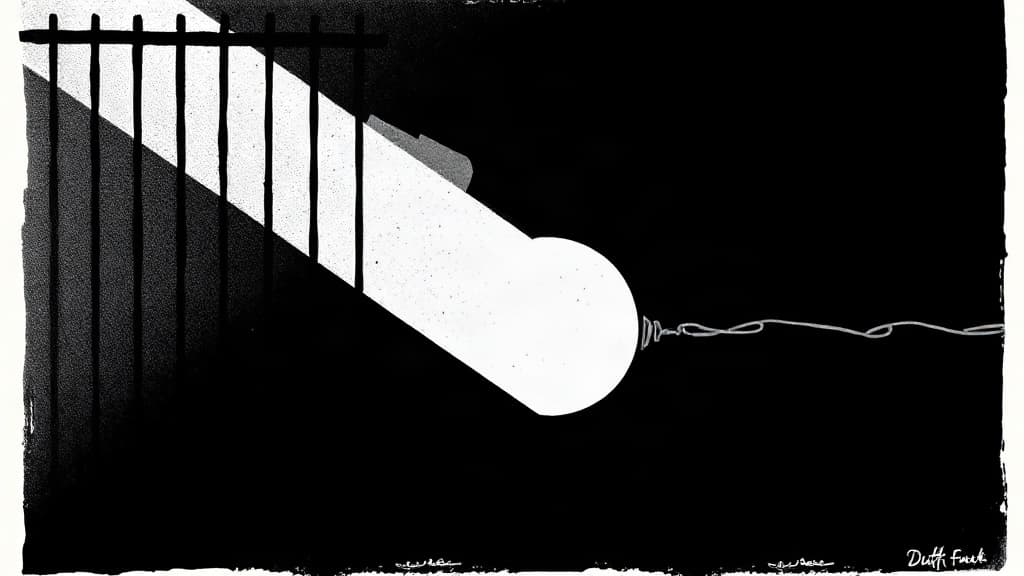
Texas officials needed 34 minutes just to find a vein. They stuck needles in a 70-year-old man's neck and foot, then pumped him full of pentobarbital — a caustic barbiturate — and he writhed, cursed, and screamed that his leg was on fire for several minutes before dying. The state calls this a success.
That's the real scandal — not that a murderer suffered, but that the government is so staggeringly incompetent it can't carry out a lethal injection without turning it into a spectacle. And the establishment press, predictably, is using this to push for abolishing capital punishment entirely, while the name of the man Reinaldo Dennes murdered — Janos Szucs, a diamond wholesaler killed during a 1996 robbery — barely earns a mention.
The Guardian ran its story under a headline about "horror and terror and pain," quoting spiritual adviser Rev. Jeff Hood at length about Dennes's agony. Hood, a prominent anti-death-penalty advocate who has witnessed 15 executions, called it the worst he'd seen — "by far." Reuters was more measured but still emphasized the "unusually protracted" procedure. Both outlets gave ample space to Dennes's cries. Neither dwelled on Szucs, who has been dead for 30 years.
Here are the facts, stripped of sentiment: Dennes spent three decades on death row for murdering Szucs. On Thursday, prison officials strapped him to a gurney at 6:04 p.m. and couldn't establish viable IV lines in his arms. After 34 minutes, they placed lines in his neck and left foot. The pentobarbital began flowing at 6:52 p.m. Dennes remained conscious and in pain for several minutes — Hood said he was still making complete sentences past 30 seconds, something the reverend had never seen before. Dennes was declared dead at 7:07 p.m., over an hour after the process began.
Texas Department of Criminal Justice spokesperson Amanda Hernandez insisted: "It was not a botched execution, it proceeded as planned and it was successful." If a man screaming in agony for minutes is your plan succeeding, that tells you everything about the state's standards of competence.
This comes after Tennessee's failed execution of Christa Pike in September, where pentobarbital left her badly injured and unconscious for days rather than dead. The drug isn't working the way officials claim it does. That's a factual problem, not a moral one — but you won't hear the press frame it that way. Reuters even worked in the incoming Democratic governor-elect Gina Hinojosa's opposition to capital punishment, a convenient political peg that turns government failure into an argument for giving government less to do for the wrong reasons.
The press wants you to conclude the death penalty is the problem. But the conclusion doesn't follow. The problem is that the state is run by people who can't execute a basic procedure competently after three decades of preparation — the same people who want to manage your healthcare, regulate your speech, and decide which businesses survive.
A government that can't reliably put a needle in a vein has no business demanding more authority over your life. That's the story. Everything else is editorial.