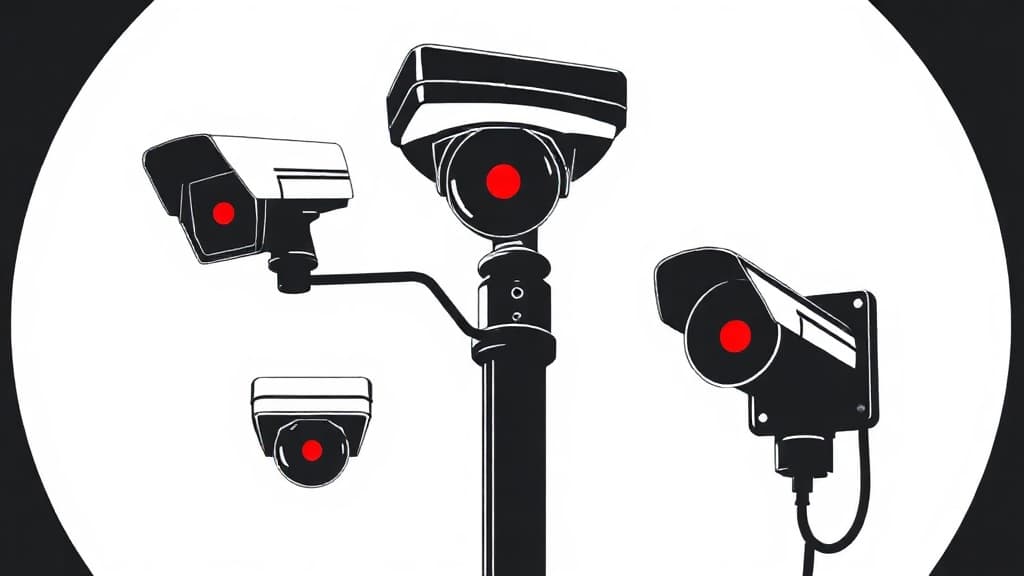
Someone cut down every single one of Winona, Minnesota's eight Flock surveillance cameras between July 29 and August 1, and the police response was to shrug and walk away. The Winona Police Department announced Wednesday it will not replace the $24,000 worth of tracking equipment — the same system it credits with catching a homicide suspect and solving multiple crimes. The surveillance state can't even protect its own eyes, but it still wants to monitor yours.
This is the contradiction that matters: a law enforcement apparatus that demands perpetual visibility into the movements of ordinary citizens couldn't be bothered to secure its own pole-mounted cameras against a pair of bolt cutters. Each camera and pole was valued at $3,000, according to Winona police. All eight were stationed in pairs along Highways 61, 14, and 43. Somebody walked up to them over a four-day window and took every last one. Deputy Police Chief Jay Rasmussen says the theft investigation remains ongoing, but no additional information is available.
Winona police called the Flock system "an effective and impactful resource for law enforcement" and insisted there have been no incidents of personnel misusing the cameras. Then they folded. "After careful consideration, Winona PD has decided not to reinstall any Flock cameras in the City of Winona," the department's announcement reads. The stated reason? Community trust. "At the end of the day, however, our community's trust is the foundation of effective policing, and we've worked hard to build and maintain that trust," the statement says.
That's a tidy exit, but it raises the question: if the cameras were so effective and so carefully managed, why abandon them after one theft? And if trust was the real concern, why were they installed in the first place without apparently accounting for the public skepticism that Flock systems routinely generate?
That skepticism is playing out in real time elsewhere. In Monterey Park, California, residents packed a city council meeting this week to challenge their own 34 Flock cameras. "People just don't want to be watched and have their privacy violated," resident Steven Kung said. "It's creepy and Orwellian." Police Chief Scott Wiese insisted the cameras only capture still photos of passing cars and retain data for 30 days, and that only local officers and dispatchers can search the system. But residents weren't buying it — and for good reason. In February, the Ventura County Sheriff's Office acknowledged that out-of-state agencies had accessed their license plate reader data more than 364,000 times. Federal immigration agents have reportedly obtained Flock data through out-of-state police departments that opt into data-sharing, circumventing state-level restrictions. Wiese conceded that if an individual officer decides to break the law and share data illegally, their own department would have to police it.
So here is where things stand: Winona installed a tracking network, couldn't keep it from being stolen, and quit rather than replace it — wrapping the retreat in language about community trust. Monterey Park installed the same network and is now fielding angry questions about data flowing to federal agencies through backdoor sharing agreements the local chief can't fully control. The common thread is a surveillance infrastructure that expands first and answers questions later, if ever.
The cameras that watch you can't watch themselves. The people who took Winona's eight cameras are still unidentified. The data flowing from similar systems across the country is still being accessed by agencies the public never agreed to share it with. The question isn't whether Flock cameras solve crimes. It's who, exactly, is being watched — and who is doing the watching when nobody is watching them.