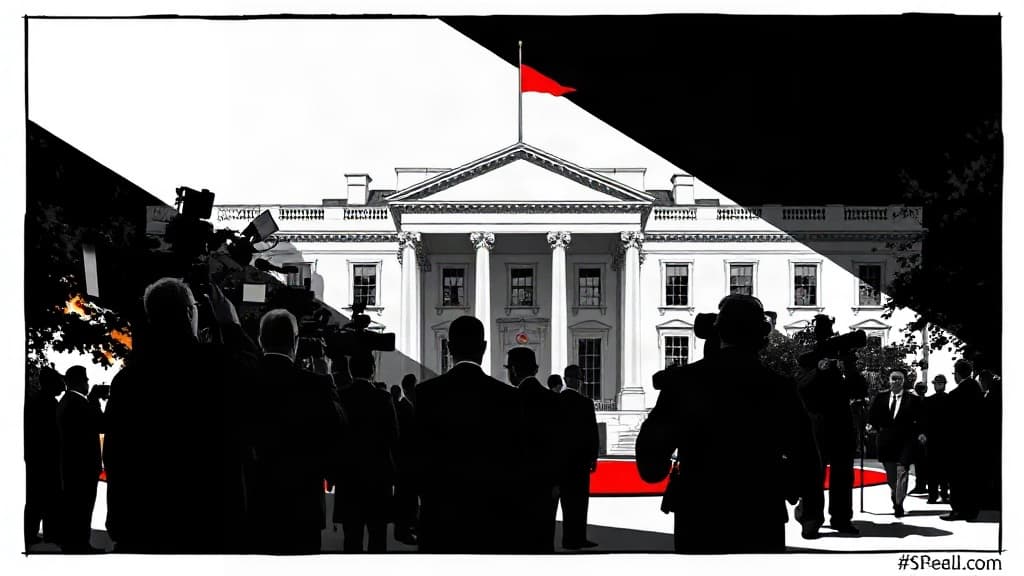
A federal judge blocked the Trump administration from banning CNN, Politico, and MS NOW from the White House complex Tuesday — preserving not just those outlets' access, but the corporate press's lock on who gets to scrutinize the executive branch.
U.S. District Judge Timothy Kelly, a Trump appointee, issued a preliminary injunction keeping the outlets' hard passes active while their lawsuit proceeds. The ruling means the same organizations that have long controlled the press briefing room — deciding which questions get asked and which stories get buried — keep their seats at the table. An independent press means nothing when the same six outlets operate as gatekeepers.
Trump announced the ban on Sept. 18 via Truth Social, writing it was "a result of their constant 'reporting' FAKE NEWS!" and warning "Other Fake News Media Outlets to follow." The ban affected 78 journalists who held hard passes — credentials that had already been screened and approved. The administration later retrofitted a national security justification, with Trump posting that the outlets' reporting was "a threat to our National Security, and must be stopped, NOW!"
Kelly wasn't buying it. "There is practically nothing national security-related in the record connected to the President's decision to revoke Plaintiffs' hard passes to which the Court can defer," he wrote in his 26-page opinion. He found Trump's own statements made clear the ban was about content — "President Trump likely banned Plaintiffs from the White House because he believes that their reporting is generally inaccurate and biased against him" — and that this violated both First Amendment and due process rights.
Notably, Kelly took pains to state his ruling "doesn't concede that Trump's concerns about accuracy and fairness are unfounded" or that the government is "powerless when its true aim is to protect national security when classified information is unlawfully disclosed." The judge acknowledged what millions of Americans already know: the credibility problem is real, even if the legal remedy Trump chose was constitutionally defective.
The injunction restores access to the White House complex but does not require the administration to admit reporters from these outlets to the Oval Office or Air Force One — locations where CNN and Politico journalists have still been blocked from pool duty in recent weeks. The White House has exploited that gap, interpreting the order narrowly to maintain exclusion from presidential movements.
First Amendment attorney Theodore J. Boutrous, representing the outlets, hailed the ruling and pointed to Trump's own candor: "The President has repeatedly, candidly, and consistently admitted in public that he banned our clients from the White House to punish reporting he doesn't like and to try to force journalists to cover him in ways he prefers."
Trump vowed to appeal before the ruling was even issued.
The deeper problem remains unaddressed: the press corps that most Americans don't trust still holds a monopoly on direct access to the president. CNN, Politico, and MS NOW have a legitimate First Amendment claim — but so do the independent outlets, freelancers, and alternative voices permanently locked out of that room. The judge protected the incumbents. The cartel endures.