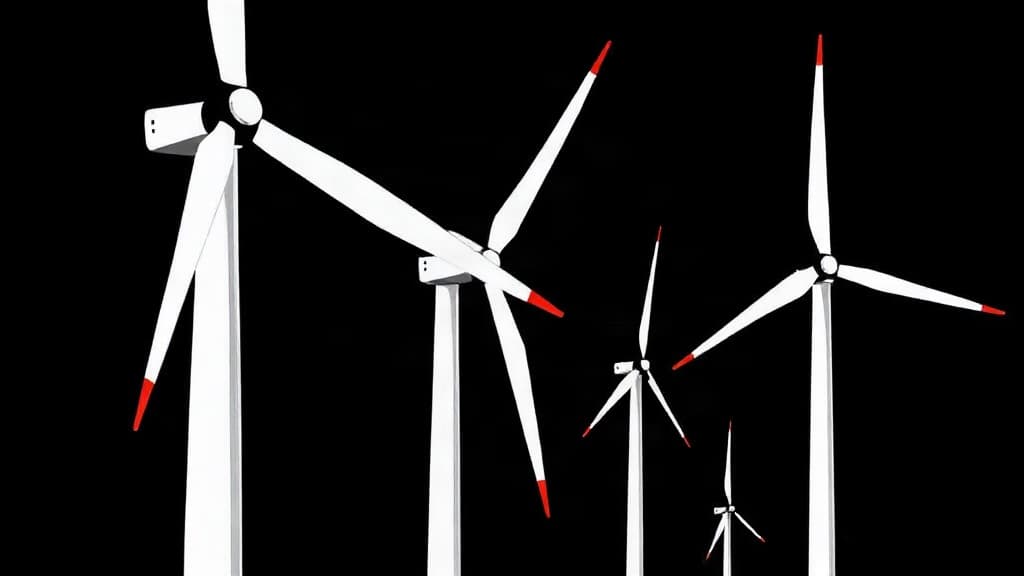
President Trump directed his Commerce Secretary and Trade Representative to negotiate on wind turbine imports and report back within 180 days — a move that puts foreign-controlled energy supply chains on notice while the establishment press barely noticed the order existed.
The executive order, released by the White House Thursday, imposes no new tariffs but explicitly reserves the right to pursue "other remedies" depending on how talks go, according to Reuters. That's the framework: negotiate first, but keep the leverage. For working Americans who pay the bill when energy infrastructure depends on adversaries or overseas competitors, the stakes are straightforward. If foreign suppliers control the turbines, they control a piece of the grid.
Commerce Secretary Howard Lutnick and Trade Representative Jamieson Greer now have 180 days to produce results. The order targets wind turbine imports specifically — a sector where domestic manufacturing capacity has withered while foreign producers, particularly in Asia, have captured market share. Trump's language in the order leaves the door open to further action, including potential tariffs, if negotiations don't deliver.
What makes the story worth watching is what the press chose to cover instead. Three of the four outlets tracking Thursday's news — NBC News, The Guardian, and the New York Post — devoted their coverage to a federal judge ordering Trump to sit for a deposition by December 11 in his $10 billion defamation lawsuit against the BBC, or risk having the case dismissed.
The BBC lawsuit has its own merits. The British broadcaster spliced together separate sections of Trump's January 6 Ellipse speech, cutting out his call to protest "peacefully" and overlaying footage of the Proud Boys marching on the Capitol, according to the New York Post. The edited product made it appear Trump encouraged the riot in a single continuous statement. The BBC's chairman later called it an "error of judgment," and its director-general and news CEO stepped down, the Post reported. Trump is pursuing $5 billion in defamation damages and another $5 billion under Florida's Deceptive and Unfair Trade Practices Act.
U.S. Magistrate Judge Enjoliqué Lett ordered Trump to sit for the videotaped deposition by December 11 after he skipped a previously scheduled October 16 date — his lawyers cited a "matter of national importance" that turned out to be a campaign rally in Georgia, according to NBC News. The Guardian reported that Lett criticized Trump's legal team for producing "absolutely nothing of any substance" in discovery and warned sanctions up to dismissal if they don't comply within 30 days.
All of that is a real story. But the contrast is the story Dissenter readers should care about: an executive order aimed at pulling critical energy manufacturing back under American control got a few paragraphs from one wire service, while three outlets chased the courtroom drama. The Guardian didn't mention the wind turbine order at all. Neither did NBC. Neither did the Post.
The question isn't whether the BBC defamed Trump — that's what courts are for. The question is who builds the infrastructure that keeps American power flowing, and whether this administration is willing to use trade leverage to make sure the answer isn't Beijing.