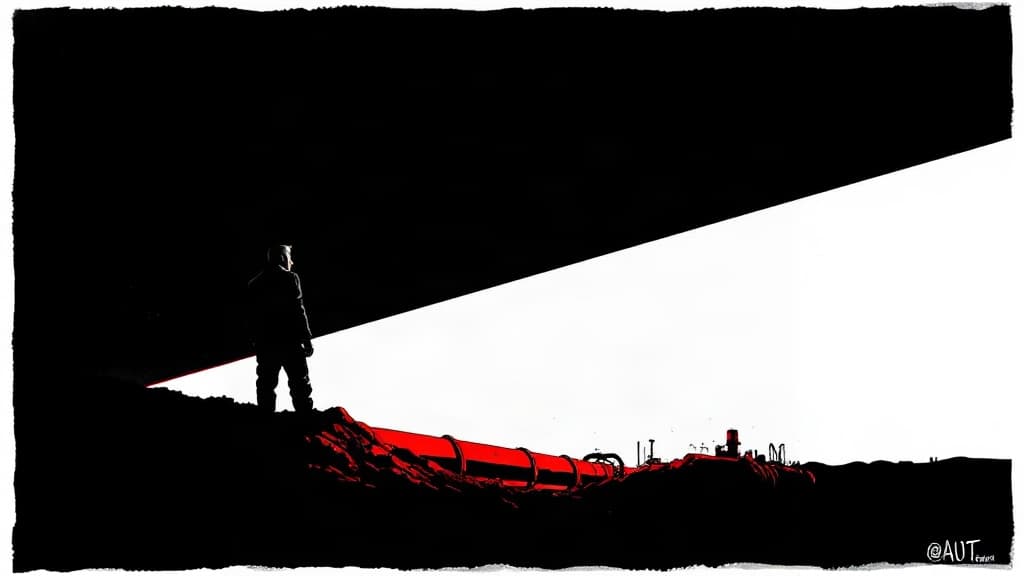
The Trump administration is invoking wartime executive powers to push up to $42 million in federal funding toward a natural gas pipeline that New York regulators strangled for nearly a decade — a direct challenge to the green blockade that has kept Northeast families paying some of the highest energy bills in the country.
The Department of Energy announced Monday that Defense Production Act funds would advance the 125-mile Constitution Pipeline, which would move natural gas from Pennsylvania to New York. Energy Secretary Chris Wright said the project could lower electricity and home heating costs and reduce blackout risks during peak demand. "Despite America having an abundant supply of low-cost natural gas, tens of millions of Americans have limited access to this reliable energy source due to a lack of pipeline infrastructure," Wright said.
The Federal Energy Regulatory Commission approved the pipeline in 2014. Then New York's Department of Environmental Conservation denied a critical water-quality certification in 2016, citing environmental concerns. Developers gave up in 2020 after years of regulatory warfare. Williams Companies, the firm behind the project, is now seeking renewed federal approval and says the pipeline could be operating by late 2028 — serving the daily equivalent needs of roughly three million Northeast homes.
The $42 million would cover permitting, environmental reviews, engineering, and other preconstruction work, according to the Daily Caller. DOE indicated additional funding could support complementary infrastructure once permits are secured.
Energy analyst Stuart Turley told the Daily Caller News Foundation the DPA move is "outstanding" and argued it should be expanded to all U.S. refineries to increase capacity and lower fuel prices without forcing consumers to cut demand.
The same establishment that never blinked when presidents invoked the Defense Production Act for foreign interventions is now wringing hands over using it to build domestic energy infrastructure. The powers were always there. The will to use them for American ratepayers was not.
And the need is real. A separate study from the Fiscal Alliance Foundation, reported by HotAir, found that expanding natural gas capacity in Massachusetts alone could save ratepayers $367 million per winter. Massachusetts currently pays the fifth-highest electricity prices in the country at 25 cents per kilowatt-hour — with natural gas supplying more than 65 percent of the state's electricity. The study promotes "Project Beacon" as a way to tap neighboring resources, but the underlying problem is the same: green policy has made energy scarce and expensive in a region that sits atop abundant supply.
New York's DEC acknowledged the developer withdrew its renewed water-quality certification application in November 2025 and disputes claims it waived review authority. Environmental groups continue raising concerns about wetlands and waterways, according to a June FERC notice. The commission prepared an environmental assessment in response.
The open question is whether federal wartime authority can override a state's refusal to permit — and whether the courts will let it. Williams Companies, DOE, New York's DEC, and FERC all declined or did not respond to requests for comment. The pipeline was approved twelve years ago. It has never moved a cubic foot of gas.