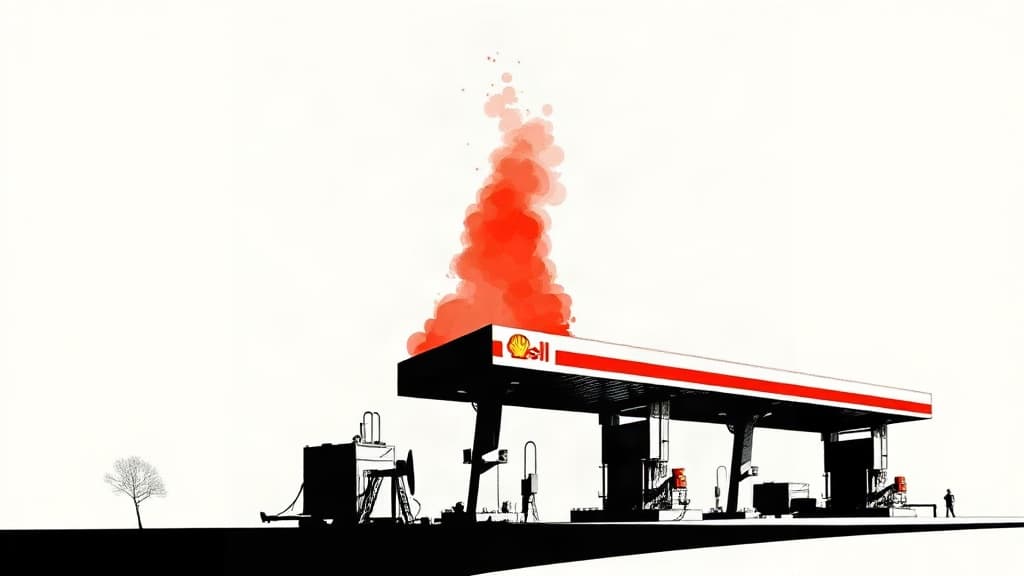
Shell just doubled its quarterly profits to over $10 billion off the back of the Middle East conflict, and every dime of it is coming out of your wallet.
The war-driven spike in oil and gas prices has handed the world's biggest energy companies record-breaking quarters while ordinary people across Europe and America absorb higher fuel costs and inflation. Shell reported adjusted profit of $10.8 billion for July through September, up from $5.4 billion the same quarter last year, according to the Guardian. Breitbart pegs Shell's after-tax profit even higher at $12.1 billion. Either way, the number has doubled. France's TotalEnergies posted a record $8.3 billion. Spain's Repsol quadrupled its profits to $5.6 billion over the first nine months of the year.
The mechanism is simple: war disrupts supply, supply constraints drive up refining margins, and those margins flow straight to shareholders. Shell's refining margin hit $42 per barrel in Q3 — up from $24 the previous quarter and crushing the prior record of roughly $28 set during the early months of the Russia-Ukraine war, per Bloomberg cited in both outlets. Global oil benchmark prices averaged $94.90 a barrel, up from $69.10 a year ago. Europe's gas price index jumped from €48 to €64 per megawatt-hour in the same span.
And where does that money go? Shell hiked its share buyback program to $5 billion for the next three months, up from $3 billion. TotalEnergies likewise lifted payouts to shareholders. Shell CEO Wael Sawan praised the "very strong results in a quarter with continued severe disruption to the global energy system" — a frank admission that chaos is the business model.
Breitbart highlighted the political fallout: the French government released 10 million barrels of diesel from strategic reserves hoping to cut pump prices by 12 to 18 cents per litre. TotalEnergies CEO Patrick Pouyanne estimated consumers would only see an 8 to 12 cent reduction. Government spokesperson Maud Bregeon urged Total to "set an example" but cautioned against "Total-bashing" — a polite way of saying the state will ask nicely but won't compel. The Guardian, meanwhile, framed the story around climate campaigners, with Greenpeace's Philip Evans declaring the profits "openly villainous" and accusing executives of "popping champagne on the deck of a sinking planet." Both outlets gave Greenpeace oxygen; neither pressed on why a war premium should be socialized onto consumers while the upside stays private.
The pattern by now is unmistakable. The Ukraine war drove record refining margins in 2022. The Iran conflict has done it again in 2026. Each time, the same companies post the same blockbuster numbers, the same campaigners issue the same statements, and the same governments issue the same toothless appeals. The only constant is the bill — and it always lands on the working man.
BP, Chevron, and ExxonMobil report Friday. Expect more of the same.
The open question: how many wars will it take before someone in Washington asks who's really paying for them?