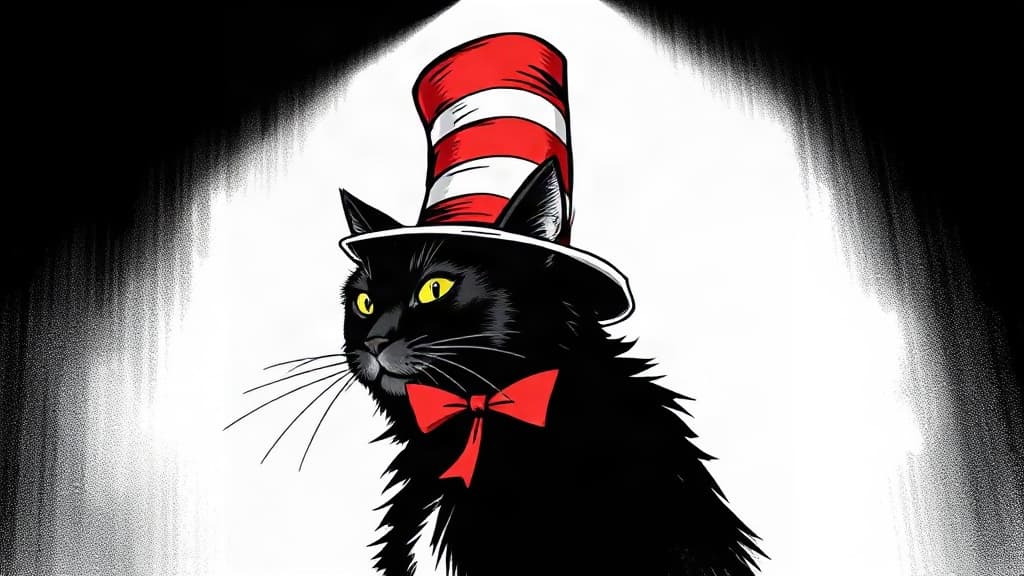
Schools across America can't keep order in their own buildings, but they've found a convenient scapegoat: a viral "Cat in the Hat" social media trend that has teenagers posting threatening AI-generated images and administrators scrambling to explain away the discipline collapse they engineered.
At least ten juveniles have been arrested and multiple schools have boosted police presence or shut down entirely — all over posts featuring a distorted version of a Dr. Seuss character prowling neighborhoods and naming targets. But the real story isn't the meme. It's that administrators who spent years undermining parental authority and abandoning disciplinary standards now act shocked when chaos fills the vacuum.
The trend originated on Snapchat in Ireland and the United Kingdom in August before spreading through the U.S. and Canada, according to the Guardian. It features AI-generated or costumed depictions of the Cat in the Hat — styled after Mike Myers' 2003 film version — lurking outside homes and schools, sometimes naming specific students or communities as targets.
The arrests are stacking up. In Hutchinson, Kansas, a 15-year-old high school student was charged with two counts of criminal threat after creating a TikTok account tied to the trend. In Worth County, Georgia, two students face charges and disciplinary action. In Grand Junction, Colorado, a 14-year-old was arrested, and police increased their presence at two local schools "out of an abundance of caution." The New York Post reports the trend has triggered ten juvenile arrests total, spanning from Georgia to Virginia, where Hanover County sheriff's deputies issued warnings after posts targeted Mechanicsville High School. In Louisville, Kentucky, a single video forced Assumption High School to close its doors in late August.
In one case that crossed from online stunt to physical threat, a teenager walking in West Kelowna, British Columbia, was chased through her neighborhood by someone dressed as the Cat in the Hat, according to the Post. She made it home safely.
Law enforcement is taking a hard line. "Regardless of whether a post is intended as a joke, it is unlawful to cause others, particularly students, to fear for their safety," the Hutchinson police said in a statement. Baldwin Park police in California echoed that posture: "Any threat directed toward our schools, students, staff, or community will not be dismissed as a joke or prank."
Fair enough — threats are threats, and kids posting target lists deserve consequences. But notice what's missing from every official statement: any acknowledgment that schools helped create the conditions where this kind of disorder thrives. When administrators lock parents out of curricula, sideline discipline as "disproportionate," and treat authority as inherently suspect, they shouldn't be surprised when students test how far the boundaries will bend. The Cat in the Hat didn't break school order. It was already broken.
The question isn't whether viral stunts are disruptive. It's who rebuilt the walls after adults tore them down.