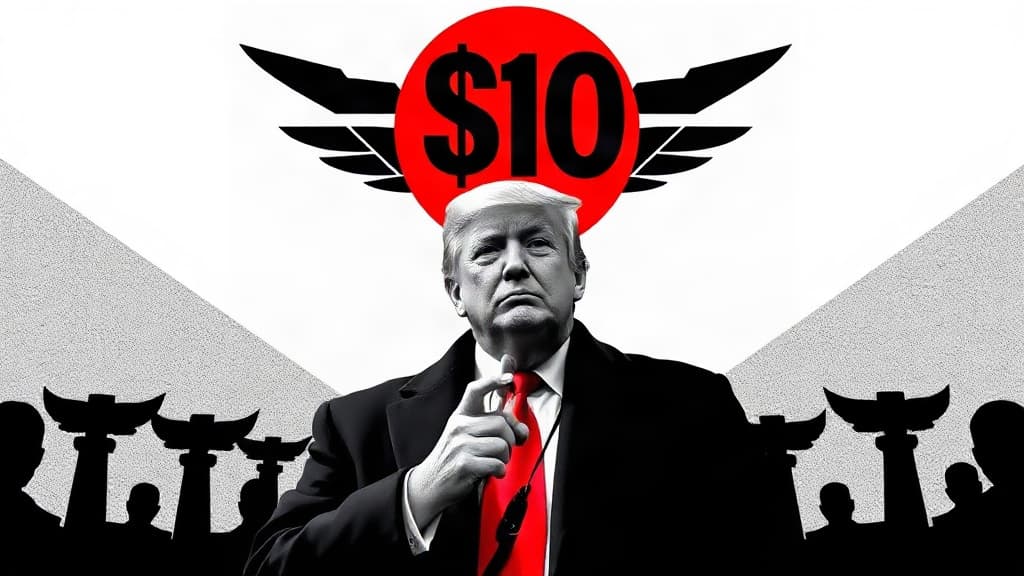
President Donald Trump pulled in roughly $1.4 billion from cryptocurrency ventures in his first year back in office—a staggering sum that landed while the Federal Reserve's inflation fight continues to hollow out working Americans' paychecks.
The numbers come from Trump's mandatory financial disclosure for 2025, released Tuesday. The 927-page document dwarfs anything seen from previous presidents—Barack Obama's final disclosure ran eight pages, Joe Biden's eleven, according to NBC News. The length, a Trump Organization representative claimed, proves "a level of financial transparency unmatched in presidential history." Critics see something else entirely: a president who refused to divest, now sitting atop a crypto empire he also regulates.
Here's where the money came from. Trump earned more than $635 million from a licensing deal with a group called "Celebration Coins," which pushed meme coins bearing his name. NBC News reported that no digital footprint could be found for the group. Senate Democrats flagged a Wyoming-registered entity called "Celebration Cards" that facilitated a crypto conference at Mar-a-Lago in April—Wyoming having become a major crypto hub. On top of that: over $236 million in additional crypto token sales, more than $65 million in equity from the Trump family venture World Liberty Financial, and over $290 million from World Liberty-associated crypto wallets.
The New York Times highlighted the sharpest angle: an investment firm tied to the United Arab Emirates bought nearly half of World Liberty Financial, blurring the line between foreign policy and private profit. That's not just a conflict of interest—that's a foreign government buying into the president's family business while he sets policy for the region.
The White House response was flat: "Neither the President nor his family has ever engaged—or will ever engage—in conflicts of interest." The Trump Organization says assets are managed by third-party institutions with automated trading. Unlike every president before him, Trump never divested or placed holdings in a blind trust.
Rice University historian Douglas Brinkley told NBC News: "There is no precedent to compare it with. No president in the 20th or 21st century has had something that's vaguely comparable."
The irony runs deep. Trump once called crypto a haven for "drug dealers and scammers," as the Times noted. Now he's its most powerful policymaker—and its most profitable operator. He made liberalized crypto regulation a centerpiece of his presidency, and the GENIUS Act and executive actions followed.
Meanwhile, the Fed keeps rates elevated, credit card debt hits records, and grocery prices stay stubborn. Ordinary Americans don't get a licensing deal with a mystery Wyoming entity. They don't get UAE-backed buyouts of their family firms. They get the bill.
Both parties have enabled this. Republicans cheer the deregulation that minted Trump's windfall; Democrats write letters but voted to confirm the same institutional apparatus that makes it all legal. The bipartisan system doesn't just tolerate self-dealing—it structures it.
The question isn't whether Trump broke the rules. The question is who wrote them, and who they were written for.