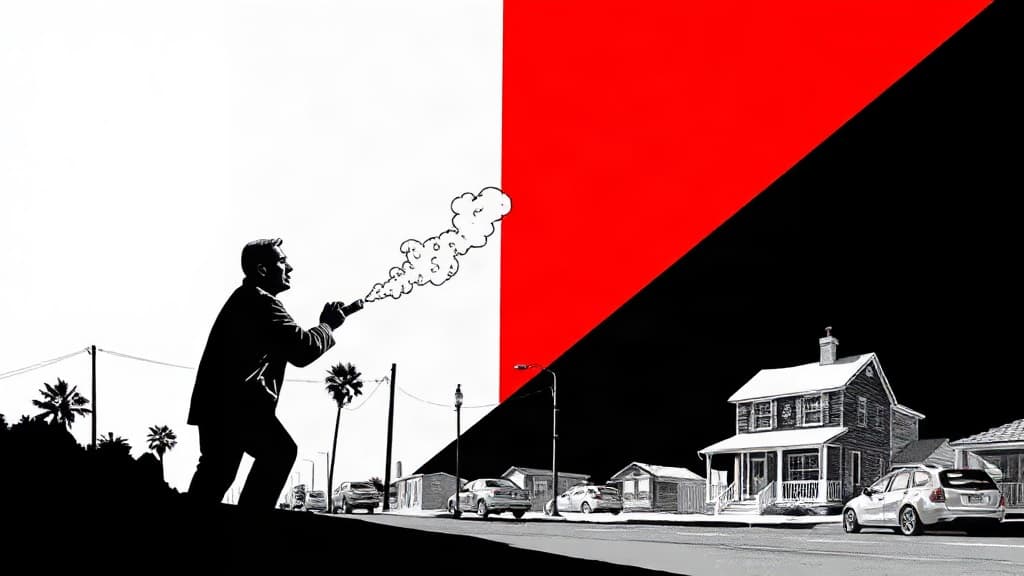
San Diego is advancing a sweeping 25-foot smoking and vaping ban around outdoor dining — the kind of regulation that lands squarely on law-abiding citizens and small businesses — even as a Category 4 hurricane menaces the Pacific coast, homes crumble into the ocean, and the governor has already declared a state of emergency.
The contrast tells you everything about where the regulatory state's priorities sit: the compliant get new rules; the dangerous get emergency declarations after the damage is done.
Councilmember Jennifer Campbell's proposal would establish a uniform 25-foot smoke- and vape-free zone around covered outdoor dining areas citywide, the New York Post reported. The City Council's Neighborhood Services Committee voted Wednesday to advance the measure to the full council. Campbell's office claims 78% of surveyed residents and 88% of surveyed restaurant workers support the ban — numbers from her own presentation, not an independent poll.
Fifteen of San Diego County's 19 jurisdictions already have similar rules on the books. A July 2025 report from San Diego State University identified San Diego as the largest city in the county without a comprehensive smoke-free outdoor dining policy. The CDC says about 2.5 million nonsmokers have died since 1964 from secondhand smoke exposure — a stat that covers six decades of indoor exposure, not people passing a vape on a patio.
Bars and nightclubs restricted to patrons 18 and older would be exempt. Private events at closed businesses would also be exempt. For everyone else — restaurants, small businesses trying to keep customers happy — one more uniform rule from a city that can't bring itself to leave well enough alone.
Meanwhile, HotAir reports that Hurricane Polo, which reached Category 5 strength before weakening to Category 4, is tracking toward Baja California with 150 mph sustained winds. University at Albany atmospheric sciences professor Kristen L. Corbosiero told the AP it is "one of the strongest storms ever in the (Pacific) Basin." It won't make direct U.S. landfall, but forecasters warn of elevated surf and high tides early next week that could bring more flooding and erosion to a coastline already battered all summer.
That battering has been real. Waves have broken onto rooftops in Long Beach. Residents evacuated along the boardwalk. Homes have fallen into the ocean. Beaches closed because the sand simply washed away. People have drowned. A rare poisonous sea snake washed up in Newport Beach, carried north by warm currents from a previous storm. Governor Gavin Newsom declared a state of emergency Monday to free up money for whatever comes next.
One track: a city committee votes to push a 25-foot vaping buffer — a rule that hits restaurants and citizens who are already following the law. The other track: the Pacific is throwing Category 5 storms at the coast, swallowing houses and killing people, and the state is scrambling for funds after the fact.
The regulatory state can mobilize committees and surveys for vape buffers. When the ocean takes your house, you get a declaration.