The Powerball jackpot has swelled to an estimated $975 million after nobody won Monday night's $905 million drawing—another spectacle built on working Americans chasing a 1-in-292-million long shot while inflation devours their paychecks. Wednesday's drawing marks the 44th consecutive roll since a May 2 jackpot was split between tickets in Texas and Florida, according to Yahoo. The cash value—the number that actually matters if you take the lump sum—is $422.3 million, less than half the headline figure. That's before Washington and your state take their cut of the winnings, too.
This is the eighth-largest jackpot in Powerball history and the biggest prize of the year, but the real story isn't the size of the pot. It's who profits. State governments run the numbers racket, skim off the top, tax the payout, and watch jackpots balloon as purchasing power shrinks. The American dream, once built on work and ownership, now dangles on a $2 ticket.
Monday's winning numbers were 6, 37, 54, 55, and 64, with a red Powerball of 10 and a 3X Power Play multiplier, per USA Today and Yahoo. The New York Post's report listed only four white-ball numbers—an apparent omission—but the other two outlets agree on the full set. No ticket matched all six. One Tennessee player hit a $2 million Match 5 plus Power Play prize, while $1 million Match 5 winners surfaced in California and Maryland, the Post reported.
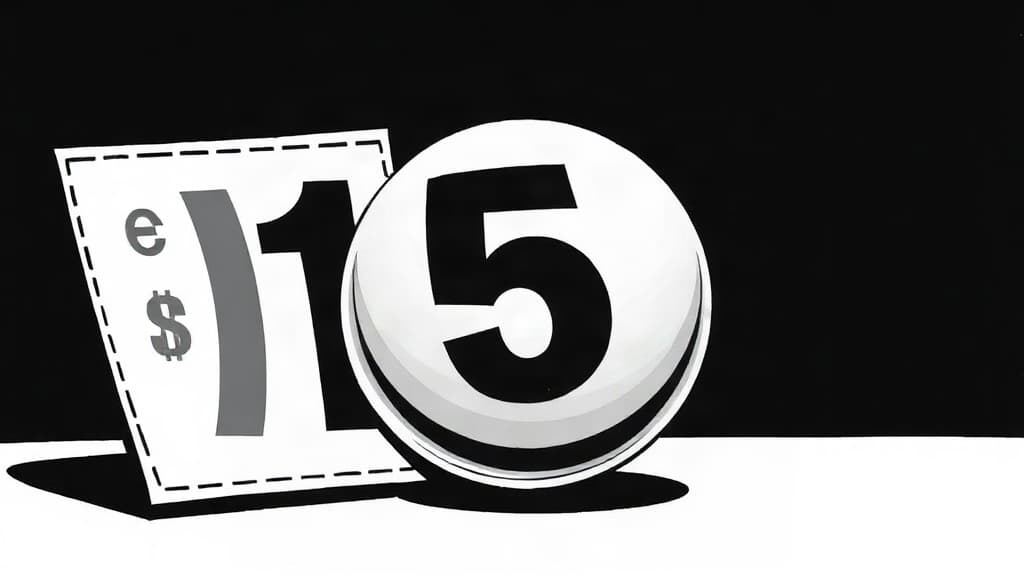
The odds of hitting the jackpot are 1 in 292,201,338. You are more likely to be struck by lightning, twice, than to walk away with the grand prize. A ticket costs $2, with optional add-ons pushing the price higher. The house always wins—and the house is the state.
Powerball is now sold in 45 states, Washington D.C., Puerto Rico, and the U.S. Virgin Islands. But the game has also just undergone what USA Today called its "biggest expansion in years": last month, tickets went on sale in the United Kingdom. British players pay 4 pounds—roughly $5.32—per ticket, more than double what Americans pay, and their sales feed the same jackpot pool while lower-tier prizes are structured differently, according to Yahoo. More players, more revenue, same impossible odds.
USA Today framed the expansion as a neutral feature note. The Post didn't mention the U.K. expansion at all. Neither outlet paused to ask why an American state-run lottery is now soliciting foreign players—or who pockets the difference.
Follow the money. State lotteries were sold to the public as funding for education and infrastructure. In practice, they function as a regressive tax: lower-income households spend a disproportionately larger share of their earnings on lottery tickets than wealthier ones. The government taxes your paycheck, inflates away your savings, and then sells you a ticket to escape the trap it built.
The last time the Powerball jackpot was won was a $20 million split on May 2. It took 43 drawings and more than three months of rolling over to get here. Each drawing without a winner means more ticket sales, more state revenue, and more hype. The largest Powerball jackpot ever—$2.04 billion—was claimed with a single ticket sold in California in November 2022. Before taxes.
The jackpot could cross the $1 billion mark by Wednesday, which Yahoo noted would be only the 15th time a U.S. lottery prize has reached that threshold. A billion dollars. For a game where your odds are functionally zero. The number isn't a measure of luck. It's a measure of how many people are desperate enough to play.