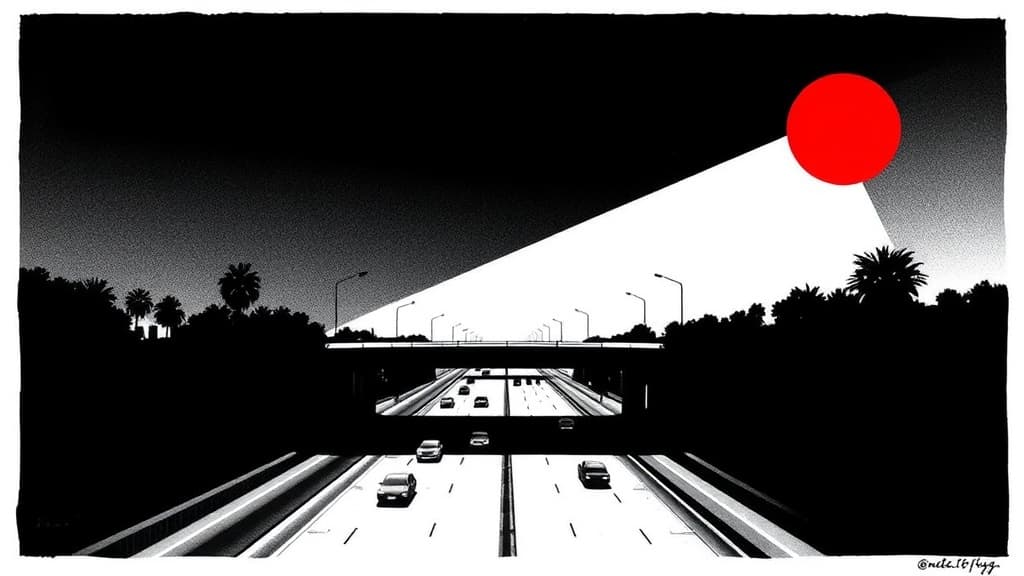
The federal government is handing Santa Monica $2 million to study ripping out a chunk of the Interstate 10 freeway and replacing it with park space — a move that, if it ever happens, would choke off a critical commuting artery for working drivers across Los Angeles County.
The Santa Monica City Council voted unanimously June 9 to accept the U.S. Department of Transportation grant, which will fund a feasibility study on building "cap parks" over the Santa Monica Freeway between 11th and 20th streets — or removing that section of freeway entirely. The study area covers roughly 25 to 30 acres in the city's Pico Neighborhood.
The money flows from DOT's Reconnecting Communities Pilot Program, a federal initiative sold as repairing neighborhoods "split apart by major transportation infrastructure." In practice, it's a pipeline for progressive urbanists who view car-dependent infrastructure as a problem to be dismantled — and who rarely commute the way a plumber or warehouse worker does.
Councilmember Ellis Raskin, who made the motion to accept the grant, called the freeway Santa Monica's "most significant environmental hazard" and dismissed merely capping it as "essentially a form of band-aid," according to the Santa Monica Daily Press. Raskin said the city should study replacing the freeway outright with parks, a "grand boulevard," or other neighborhood-serving uses.
City officials claim the freeway displaced more than 1,500 residents when it was built, severing what they describe as a predominantly black and Latino community. Council members insisted displaced residents be "centered" in the process. But the people who drive that corridor every day — tens of thousands of them — had no seat at the table.
The grant will not fund construction or a final design. It pays for a feasibility study: existing conditions, possible park locations, and cost estimates. A final report isn't due until July 31, 2029. The city expects to hire a consultant, with work starting spring 2027.
There's the money trail. A $2 million federal grant plus a $505,712 local match — covered through staff time and Park and Recreation Development Impact Fee revenues — and the first order of business is cutting a consulting contract. Follow who gets hired. Then follow who owns the real estate adjacent to a 30-acre park where a freeway used to be. Property values in Santa Monica are already among the steepest in the country; erase a noisy, congested freeway and replace it with greenspace, and the landholders on either side win big.
Senior Park Planner Antonio Lopez pitched the concept simply: "It's basically a park on top of a highway." But a park on top of a highway still has a highway under it. Raskin's stated goal — removing the freeway entirely — is the real play, and everyone in the room knows it.
Councilmember Caroline Torosis asked staff to move faster if possible: "If there's any way to do it quicker than 2030, we would love that."
The I-10 is a major east-west interstate carrying hundreds of thousands of vehicles daily. Eliminating even a short stretch would force that traffic onto surface streets — streets that serve the neighborhoods the council claims to be protecting. Working people who drive to earn a living get longer commutes, more fuel costs, more wear on aging vehicles. The coastal elites get a park.
The federal Reconnecting Communities program treats roads as historic injustices. For the millions who rely on them to get to work, they're just the way they pay the bills.
The study won't be done for years. The question is whether the people who actually use the freeway get a say before the consultants and the landowners decide what happens to it.