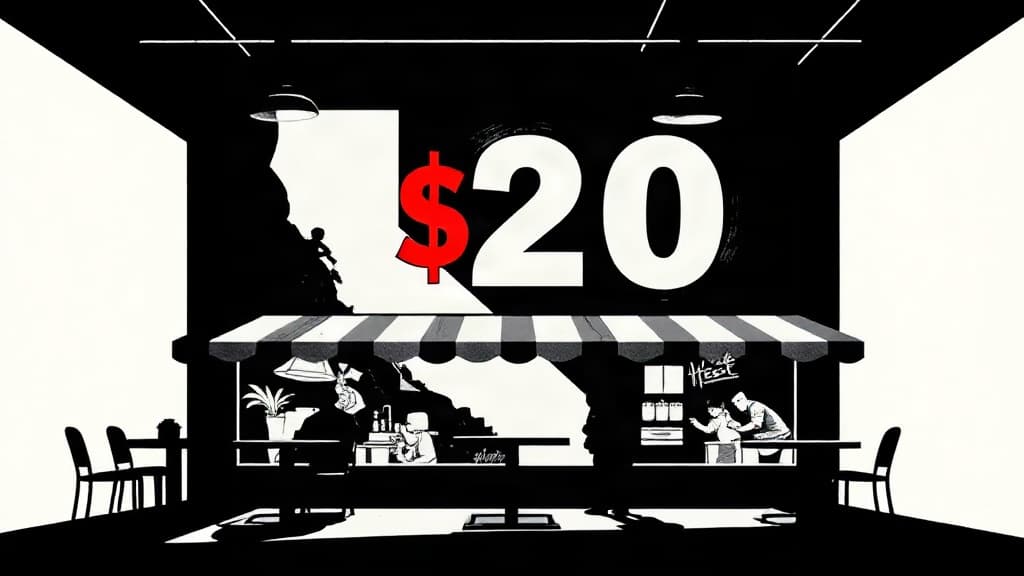
California politicians sold the state's $20 fast-food minimum wage as a victory for workers. The reality is playing out in bankruptcy court — where restaurant operators are going bust, workers are losing jobs, and corporate giants are scooping up the wreckage at pennies on the dollar.
San Diego-based Cerca Trova Restaurant Group, which operated 61 Outback Steakhouse locations across five states — the majority in California — filed for Chapter 11 bankruptcy protection Monday, drowning in $449 million of debt. CEO David Goronkin didn't mince words in court documents cited by the Los Angeles Times: "By 2026, the pressures on the business had converged. Guest traffic and earnings continued to decline, while food, labor, and other production costs continued to rise."
California's statewide minimum wage jumped to $16.90 an hour in January, while fast-food chains have been forced to pay at least $20 an hour since 2024. Though Outback Steakhouse is technically exempt from the fast-food mandate, the broader wage floor still drives up payroll across the industry. More than half of Cerca Trova's workforce is employed in California. The chain has already shrunk from 99 restaurants in 2018 to 61 today, with multiple California locations recently shuttered.
Follow the money. Cerca Trova's debt ballooned from roughly $269 million in late 2020 to $449 million this year. Now Outback's parent company, Florida-based Bloomin' Brands, has emerged as the leading bidder to acquire the bankrupt franchisee's assets for just $26.3 million — a fraction of the debt load — while providing $5.5 million in financing to keep operations running during bankruptcy. Bloomin' Brands told the New York Post the meltdown is "an isolated situation involving the franchisee." But when corporate parents can buy back their own franchises at fire-sale prices after government mandates bankrupt the independent operators, consolidation isn't a bug — it's the business model.
It's not just corporate chains getting hammered. "Breaking Bad" actor Dean Norris and his estranged wife Bridget filed for Chapter 11 bankruptcy for their Swing Inn Cafe in Temecula, California, according to court documents obtained by Page Six and TMZ. The diner, open since 1927, holds just $147,809.58 in assets against $1,811,598.46 in liabilities. Norris stated in bankruptcy filings that the restaurant suffered a steep $1 million decline in gross revenue from 2024 to 2025. The couple is simultaneously divorcing, with Bridget citing "irreconcilable differences" and seeking spousal support.
A major Carl's Jr. franchise operator, Friendly Franchisees Corporation, also recently sought Chapter 11 protection through its subsidiary, the New York Post reported.
The pattern is clear: Sacramento mandates higher wages, operating costs soar, customers stop showing up, and the independent operators go under. The corporate parents and deep-pocketed consolidators pick up the pieces at a discount. The workers the politicians claimed to champion? They lose their jobs entirely.
The question California's working class ought to be asking: when the next wage mandate gets passed, who actually cashes the check — and who writes it?