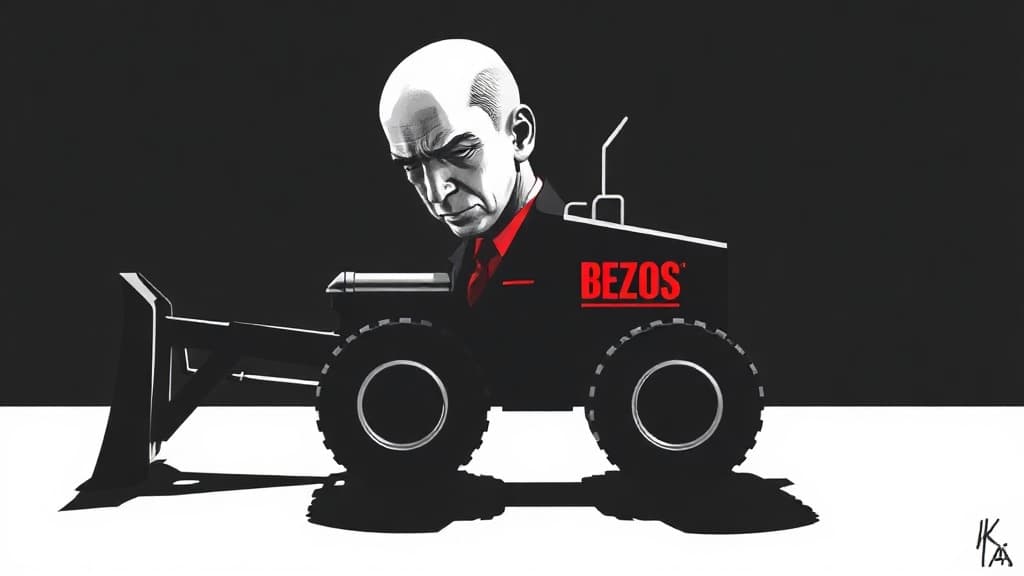
Amazon founder Jeff Bezos wants you to know that artificial intelligence isn't coming for your job—it's coming to help you do it faster. The second-richest man in America just needs you to believe that while he cashes in on the technology himself.
Speaking on CNBC's "Squawk Box" on May 20, Bezos framed AI as a simple upgrade: "It's like you've been digging out a basement for your house with a shovel, and somebody is about to hand you a bulldozer. You should be so happy." The work doesn't disappear, he argued—it just "is going to be done at a higher level."
That's a comforting story from a man whose fortune was built on automating warehouses and crushing small retailers. Bezos pointed to software engineering and radiology as fields where AI speeds up parts of the job without replacing the people behind it. But he didn't mention the warehouse workers, the delivery drivers, or the customer service reps—the people actually most vulnerable to being swapped out for algorithms his companies are developing.
Barchart reported Bezos's comments uncritically, treating the bulldozer analogy as folksy wisdom rather than a self-serving pitch from a man with direct financial stakes in AI adoption. Bezos is helping lead AI startup Prometheus, a detail Barchart buried deep in its coverage. Follow the money: the man telling you not to fear AI stands to profit handsomely if you accept it without resistance.
Bezos also dismissed concerns about an AI bubble, arguing that even if the boom goes bust, the investment will produce lasting breakthroughs. "The good ideas will pay for all of the losers," he said. Easy to say when you're not one of the losers. When the bubble pops, it won't be billionaires eating the losses—it'll be the workers who were promised retraining that never came and the small businesses that couldn't compete with venture-subsidized automation.
The Atlantic, meanwhile, wasn't covering the AI-jobs story at all—it was reviewing an episode of House of the Dragon. That a fantasy television review ran alongside the Bezos economic narrative in the same media ecosystem tells you something about where elite cultural priorities sit: entertain the public while the billionaire class reshapes their livelihoods.
Bezos's central claim is that economies grow when people produce more with better tools. That's not wrong on its face. But the bulldozer doesn't belong to the ditch-digger—it belongs to the boss. And when the boss owns the bulldozer, he decides who gets to operate it and who gets replaced by it.
The open question isn't whether AI makes some jobs easier. It's who controls the technology, who profits from it, and who gets left behind when the people selling it tell you to stop worrying.