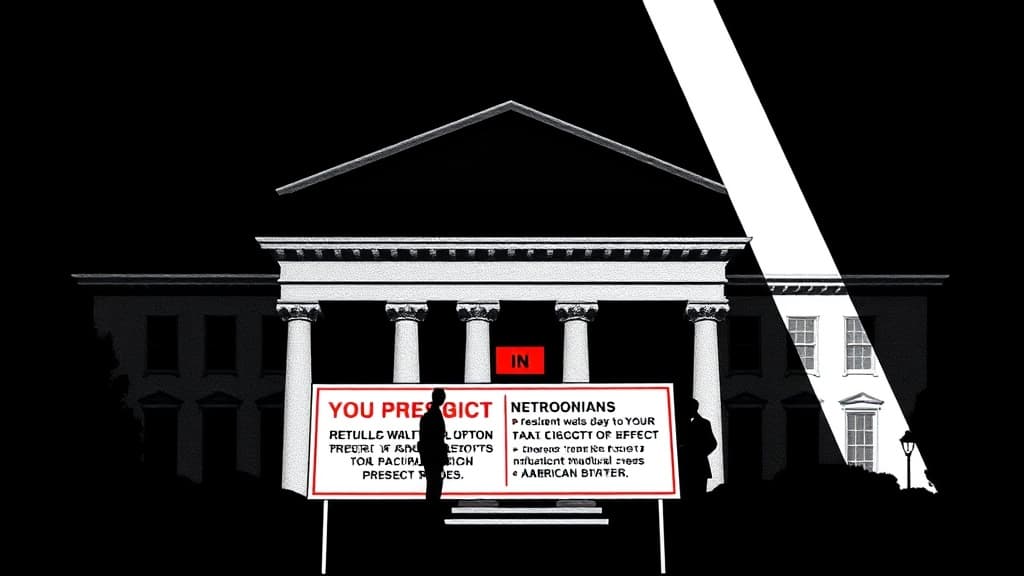
President Trump ordered the installation of corrective signs outside the Smithsonian's National Museum of American History on Friday, using federal property rights to push back against what his administration calls ideologically captured exhibits that smear the nation's founders — all funded by the American taxpayer to the tune of roughly $670 million a year.
The Smithsonian operates independently of the executive branch, so Trump cannot simply fire the curators or rip out the displays. What he can do is control the National Park Service sidewalks leading to the building's doors. That is exactly what Friday's executive order does — directing Interior Secretary Doug Burgum to place temporary signage along NPS-maintained walkways informing visitors that the museum presents inaccurate history and pointing them to better sources.
The order follows a July 4 White House Domestic Policy Council report titled "Saving America's Story," which found that Smithsonian leadership "explicitly adopted an ideological framework that no longer treats the American story as a shared national inheritance to be taught or celebrated, but as a political instrument to divide, dispirit, and discourage our citizens." The report accused the museum of treating American history as a "prime tool" to advance social justice and "the radical transformation of our society."
The March executive order laid the groundwork, directing the Smithsonian's Board of Regents — which includes Vice President JD Vance and Chief Justice John Roberts — to eliminate "improper, divisive, or anti-American ideology" from the institution's 21 museums.
Museum Director Anthea M. Hartig pushed back hard during congressional testimony this month. "As we continue to fact check the report, we unwaveringly attest that it does not fairly or accurately characterize the full body of work at the museum," she told lawmakers. Smithsonian Secretary Lonnie Bunch echoed that line in an email to NBC News, calling the White House report "not a fair characterization."
The establishment press is framing this as dangerous political interference. The BBC called the signs "warnings" and highlighted Rep. Melanie Stansbury's claim that the order is "a clear political overreach, driven by an ideological agenda to rewrite American history." The Guardian went further, calling it an "escalation" of Trump's "attacks" — burying the fact that the museum's own leadership admitted under questioning that exhibits include "overtly sexual things" that Republican lawmakers flagged.
The American Historical Association defended the Smithsonian's "commitment to scholarship and accuracy," arguing that "political interference in professional museum work threatens the accuracy of historical interpretation." What the AHA did not explain is why professional historians allowed the nation's flagship history museum to become a vehicle for Marxist framing in the first place.
The Smithsonian receives roughly two-thirds of its approximately $1 billion annual budget through federal appropriations. White House official Lindsey Halligan put it plainly: "American taxpayers should not be funding institutions that undermine our country or promote one-sided, divisive political narratives."
The open question is whether signage on the sidewalk is enough. The museum's leadership has shown no willingness to reform. The Board of Regents has not acted. And the same permanent class that captured the institution is now circling the wagons to protect it. Signs on the walkway are a start — but the real fight is over who controls the story inside the building, and whether a taxpayer-funded institution can continue to treat the American founding as something to be apologized for rather than celebrated.