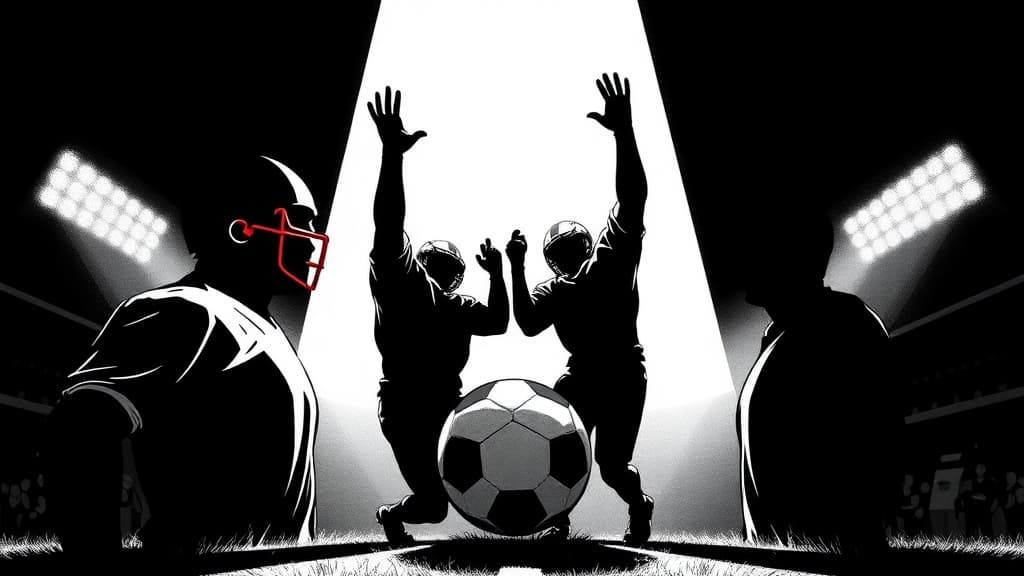
The World Cup is playing on American soil this summer, and already the usual suspects are floating whether college football should adopt soccer's rules — a move that would remake an American tradition in Europe's image and hand referees power no official should have over our game.
The Naples Daily News laid out exactly what that would look like, and it ought to alarm anyone who loves Saturdays in the fall. Under FIFA's red-card rule, a targeting ejection wouldn't just sideline a player — it would force his team to play 10-on-11 for the rest of the game. The Daily News noted that Miami cornerback Xavier Lucas was ejected with roughly 10 minutes left in the Fiesta Bowl semifinal for a questionable targeting call. Under soccer rules, Ole Miss would have gotten an extra-man advantage for the entire finish. One referee's judgment call would decide a playoff game.
Then there's stoppage time — the FIFA system where a running clock ticks toward 45 minutes and a referee adds mystery minutes at his own discretion. The Daily News pointed out that the game rarely ends exactly when stoppage time expires, especially if a team is on the attack. England's goalkeeper Jordan Pickford was furious when refs allowed corner kick after corner kick for Mexico beyond the announced stoppage window. In college football, the clock is visible, the rules are clear, and every fan in the stadium can count. Soccer's system replaces that transparency with a referee's whim.
Meanwhile, the billions poured into American soccer haven't moved the needle. The Associated Press reported that the U.S. men's national team remains stagnant after a quarter-century of investment, eliminated in the round of 16 yet again — this time in a 4-1 loss to Belgium. Christian Pulisic admitted the team still has "that next step to come." For all the money and all the hype, the Americans are soccer plebians. So naturally, the instinct is to drag the American game down to soccer's level rather than let our product speak for itself.
The World Cup's political sideshows only reinforce why our games should stay our games. Egypt's head coach Hossam Hassan used his World Cup platform to champion the Palestinian cause, according to the AP, and Egyptian fans in Cairo coffee houses celebrated that activism alongside the team's historic knockout-round run. That's their business. Our business is keeping institutional meddlers from importing the same chaos into American stadiums.
One telling detail: AP News reported that U.S. striker Folarin Balogun's red card suspension was lifted after a phone call from President Donald Trump. If soccer's own discipline system bends to political pressure from heads of state, imagine what it would do in a country where college football governors and senators already meddle with playoff committees.
College football has its problems. Referee inconsistency is one of them. The answer isn't handing those referees more power with fewer checks. The answer is the same one the founders would have given in any tavern under British rule: keep the rules visible, keep the power dispersed, and leave our game alone.