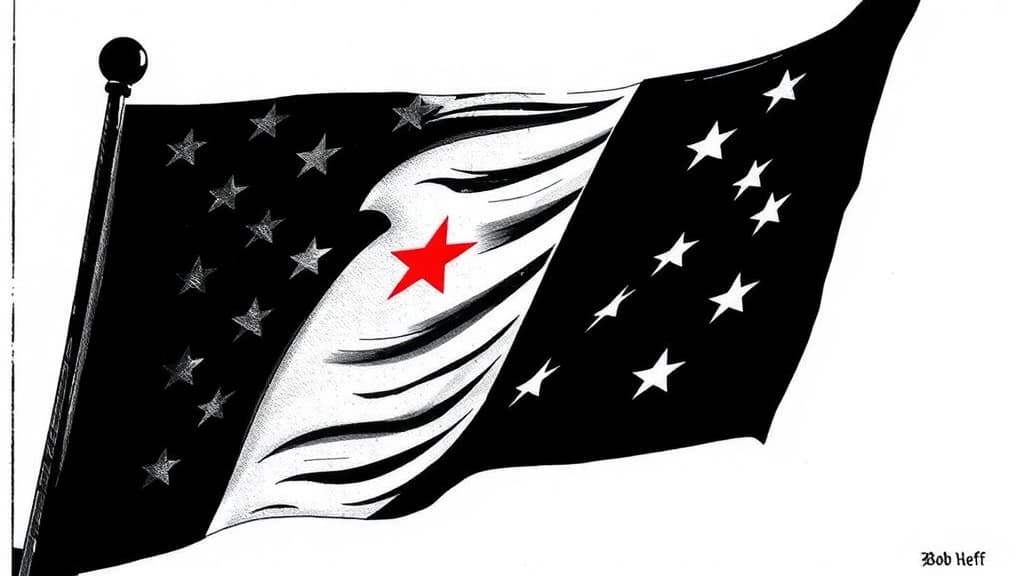
A 17-year-old high school junior from Lancaster, Ohio, designed the 50-star American flag as a history class project, sent it to the White House, and got it adopted—and the education establishment has memory-holed his story ever since.
This is exactly the kind of civic narrative that reminds ordinary Americans their ingenuity can shape the republic. It's also exactly the kind of story institutional education doesn't want in curricula: a self-taught teenager, working outside any credentialing apparatus, who bypassed the experts and landed his design on the flagpole of the free world.
Bob Heft sewed his 50-star flag in 1958 as a school assignment. He then mailed it to President Dwight D. Eisenhower, asking him to adopt the design when Hawaii became the 50th state. Eisenhower's chief of staff Wilton B. Persons replied with a letter of thanks. Heft pressed his claim in follow-up correspondence with White House officials, writing: "I made and flew the first 50-star flag in the United States. The flag was first flown March 7, 1959, and there are none recorded before this date...it has been displayed in the White House in Washington and also the Governor's mansion and capital building in our state of Ohio."
Heft, who died in 2009, spent his life telling his story to school groups, veterans, and reporters. "I, of course, designed the flag of our country, the current flag," he said. "It's not just a piece of cloth, it's the fabric of America."
The documentary evidence is substantial. Heft's flag flew over at least 40 state capitol buildings from 1960 to 1962, including New York, California, Massachusetts, Pennsylvania, Illinois, Mississippi, Alabama, Arkansas, Iowa, Utah, Nebraska, and Alaska. Ohio Governor Michael DiSalle wrote Heft confirming he was "pleased to verify your story that yours was the first 50-star flag displayed in Ohio on Ohio property." Texas Governor Price Daniel confirmed the flag flew over the state capitol in Austin on October 5, 1960, noting it "would have been displayed all day except for a rain and high wind."
Fox News, which covered the story as part of its "Crazy America History" series on Fox Nation, raised the question of whether Heft's story is true—but framed the doubt as an open question rather than a debunking. The Daily Caller, meanwhile, didn't cover Heft's story at all, opting instead for a lawsuit against Snapchat over child exploitation. Both stories involve what powerful institutions allow to happen to kids; only one remembers what a kid once did for his country.
The skepticism around Heft's claim follows a familiar pattern: a citizen with no institutional backing makes a contribution, and the gatekeepers demand proof they never demanded of themselves. Did Heft design the flag first, or were officials simply fooled? The correspondence suggests the White House took him seriously enough to answer. The state governors took him seriously enough to fly it.
The real question isn't whether Bob Heft's stitchwork was the first—it's why a story this American has to be excavated from the archives at all.