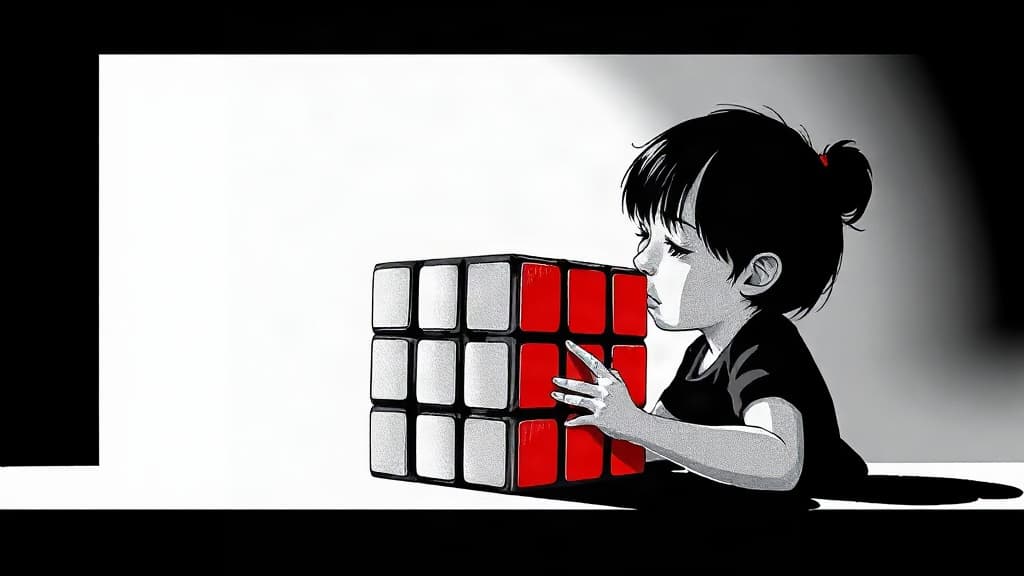
A six-year-old Chinese girl now holds the women's world record for Rubik's Cube speedsolving — and the press is celebrating it as a triumph rather than asking what it says about competitive categories that claim to protect women's achievement.
If a first-grader can stand atop the "women's" podium, what exactly is the category protecting? In physical sports, the case for sex-segregated competition rests on biological differences in strength, speed, and endurance. Rubik's Cube solving is a test of pattern recognition, spatial reasoning, and motor dexterity — none of which require a separate women's bracket to ensure fair competition. Yet the World Cube Association maintains one, and the press cheers when a child breaks it, as though the category itself means something.
Lian Yunzhi, nicknamed "Zhizhi," broke the women's 3x3 average world record twice this month at World Cube Association-certified competitions in Wuhan and Guangzhou, according to China's state broadcaster CCTV. She posted averages of 4.52 and 4.27 seconds across five solves, becoming the first female speedcuber to average under 4.5 seconds.
Her mother, Lin Yangxi, told Chengdu's Red Star News that Lian was introduced to cubing through an extracurricular class and now practices two to three hours daily, having mastered more than 1,300 solving algorithms. "Solving a Rubik's Cube improves focus, memory, logical thinking, spatial awareness, and helps develop a healthy mindset toward winning and losing," Lin said. "It's not just about blindly memorising formulas, but using logical reasoning to find optimal solutions."
The Guardian covered the story straight in both its technology and world news sections, calling Lian a "girl" and noting the "women's" record — terms that align with biological reality but that the same outlet routinely blurs in other contexts when covering transgender athletes in women's sports. Neither Guardian piece raised a single question about why a mental competition maintains a gendered category at all, or what it means when that category's record holder hasn't yet lost her baby teeth.
This is the logical endpoint of treating "women's" categories as untouchable totems rather than tools with a specific purpose. When institutions carve out protected brackets by gender in disciplines where sex confers no physical advantage — and then celebrate a child's dominance of that bracket as progress — they aren't protecting women. They're rendering the word meaningless. The same press that insists women's categories must exist to preserve fair competition also refuses to define what "women" means, and now celebrates when a six-year-old exposes the incoherence.
Lian Yunzhi is remarkable. The category she dominates is not.