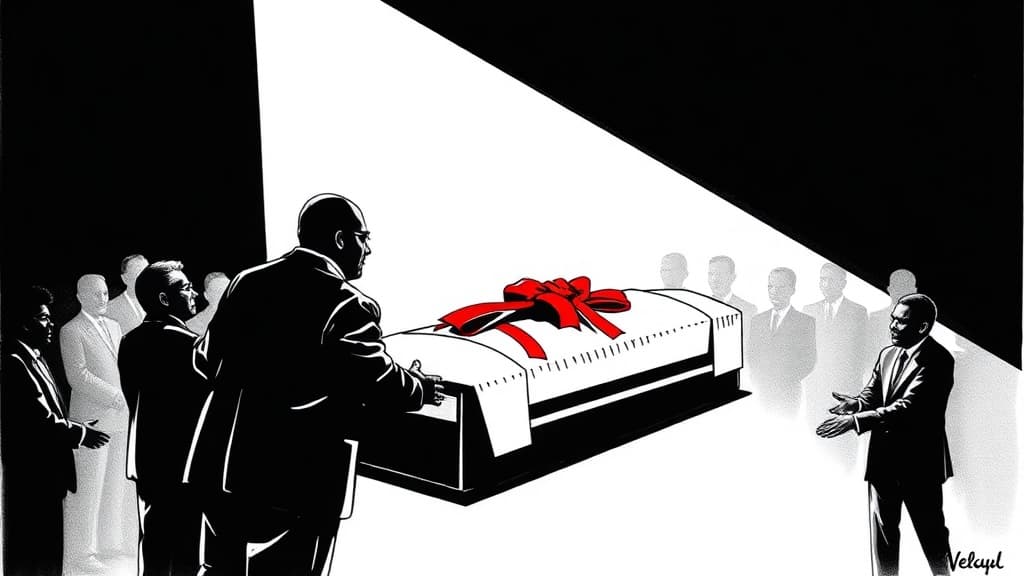
An 18-year-old Mississippi college freshman is dead, two autopsies can't say how or why, and the throat organs that might have provided answers were removed and never returned — another case where the institutions demanding public trust can't deliver basic accountability to an American family.
Nolan Wells vanished July 4 during a boat trip to Horn Island, a barrier island off the Mississippi Gulf Coast accessible only by water. His friends told police their boat was taking on water and they had to leave early; Wells, they said, opted to stay and catch a ride back with others. He never came home. His mother reported him missing around midnight. A U.S. park ranger found his body on the island's northwestern shore on July 6.
An independent autopsy commissioned by the family and performed by Dr. Roger Mitchell — a board-certified forensic pathologist and former Washington, DC, chief medical examiner — returned cause and manner of death as "undetermined, pending investigation." Mitchell could not determine whether Wells was conscious when he entered the water or how he ended up there. He could not rule out foul play.
The gaps are staggering. By the time Mitchell received Wells's body on July 10 — four days after recovery — decomposition was advanced enough that bruising couldn't be distinguished from decay. The internal neck structures had been removed during Mississippi's initial autopsy and were not available for review. "Therefore, this pathologist cannot rule out injury to the neck as a contributor or a cause of death," Ben Crump, the family's attorney, said Wednesday at the NAACP National Convention in Chicago. The stomach and other organs were also removed before the second autopsy, meaning stomach contents couldn't be examined. No toxicology report has been completed by either examiner.
A 12-by-8-inch red discoloration on the back of Wells's head could indicate trauma — or could be a decomposition artifact. The report found no lacerations or fractures.
Christine Wonsley, Wells's mother, said a member of the Cajun Navy told the family Wells was found fully clothed and face down. The last known photos of the teen show him shirtless. "We always taught him that if you go with a group, you stay with a group," his father, Elmore Wonsley, said on Good Morning America. "If you go with five, you come back with five."
Jackson County Sheriff John Ledbetter said shortly after the body was recovered that he did not suspect foul play — a conclusion the family called premature. The Jackson County coroner's autopsy results remain unreleased, pending toxicology. Dr. Michael Baden, the former New York City chief medical examiner, told the New York Post after reviewing the preliminary findings that "there's nothing dependent on foul play" — but the sentence cuts off there.
The racial dimension has drawn national attention. Wells was Black; most of the 300 to 400 people on the island that day were white. Crump said it strains credulity that no one knows what happened to one of the few Black people present. NAACP President Derrick Johnson, opening the press conference, conceded the death may have been accidental but said the family deserves real answers either way: "If it was truly an accident, then the families will have the necessary answers that any family deserves in this situation."
Colin Kaepernick paid for the independent autopsy. Tyler Perry covered funeral expenses and, alongside the Rev. Al Sharpton, is offering a $100,000 reward for information leading to an arrest and conviction. The New York Post reported that a friend said Wells had been drinking alcohol that day but seemed "fine."
Two autopsies, missing organs, no toxicology, a sheriff who ruled out foul play before the body was cold, and a state that still hasn't released its findings. The same establishment that lectures Americans about trusting experts can't tell a grieving family how their child died — and the gaps in the record are exactly where accountability should be.