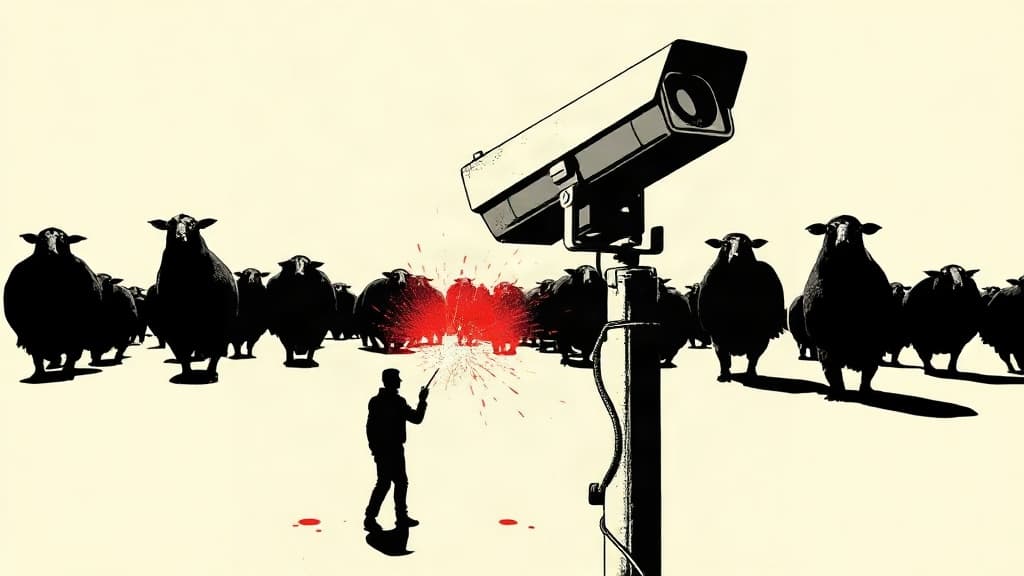
Someone in Kalispell, Montana, knocked over a Flock surveillance camera in September, and another vandal spray-painted at least two of the devices bright orange. The local press called it crime. A lot of citizens called it justice — one Facebook user even offered bail money for the culprit. The real story isn't vandalism. It's that private companies and local governments are stitching together a nationwide vehicle-tracking network without a vote, without a warrant, and without the consent of the people being watched.
The Kalispell Police Department is investigating two acts of vandalism — reported Sept. 26 and Sept. 28 — at the Lowe's parking lot in North Kalispell, according to Chief Jordan Venezio. The Daily Inter Lake identified four Flock cameras mounted on each corner of that lot, two strapped to light poles and two mounted about eight feet from the ground. The vandals heavily damaged the cameras and tried to rip them off the property.
Here's what matters: there are no government-owned license plate readers in Kalispell. Venezio confirmed that. But the cameras are there anyway — installed by a private corporation on private property, capturing every license plate that enters and exits that lot and feeding it into Flock Safety's centralized, searchable database. Lowe's uses the data for parking enforcement, theft prevention, and what its privacy policy vaguely calls "security." The data is stored for up to 90 days. Lowe's may share it with law enforcement on request.
So the government doesn't own the cameras, but the government can get the data. That's the shell game. Venezio insisted his department has never accessed automated license plate readers in the city for law enforcement purposes and would need a subpoena or search warrant to do so. "It would be no different than if we saw a camera on someone's house," he told the Inter Lake.
Except it is different. A Ring doorbell films one doorstep. Flock's high-speed cameras capture every plate on every car at every equipped location and store it in a searchable database that law enforcement and private companies can use to track vehicle movements over time, according to the Electronic Frontier Foundation. That's not a doorbell. That's a dragnet.
And Venezio admitted that on two occasions, his department asked federal and regional agencies to pull data from their own camera systems when "dangerous individuals posed a public safety threat." The infrastructure is already being used, just through a side door.
Flock Safety has captured the bulk of public anger nationwide as backlash to license plate readers has mounted. In Kalispell, that anger is visceral. When the City Council considered buying the technology for parking enforcement, residents from inside and outside the city packed meetings in opposition. When photos of the toppled and spray-painted cameras hit Facebook, users praised the vandals as heroes.
The Fourth Amendment was written for exactly this moment — when the state, or its private proxies, can track the movements of every citizen going about their daily business without probable cause or judicial oversight. The question isn't whether vandalism is legal. It isn't. The question is whether a free people are expected to simply accept being watched everywhere they go, by a company they never hired, under terms they never agreed to, in a database they'll never see.
Lowe's did not respond to a request for comment. Flock Safety keeps building. And the people of Kalispell keep pushing back.