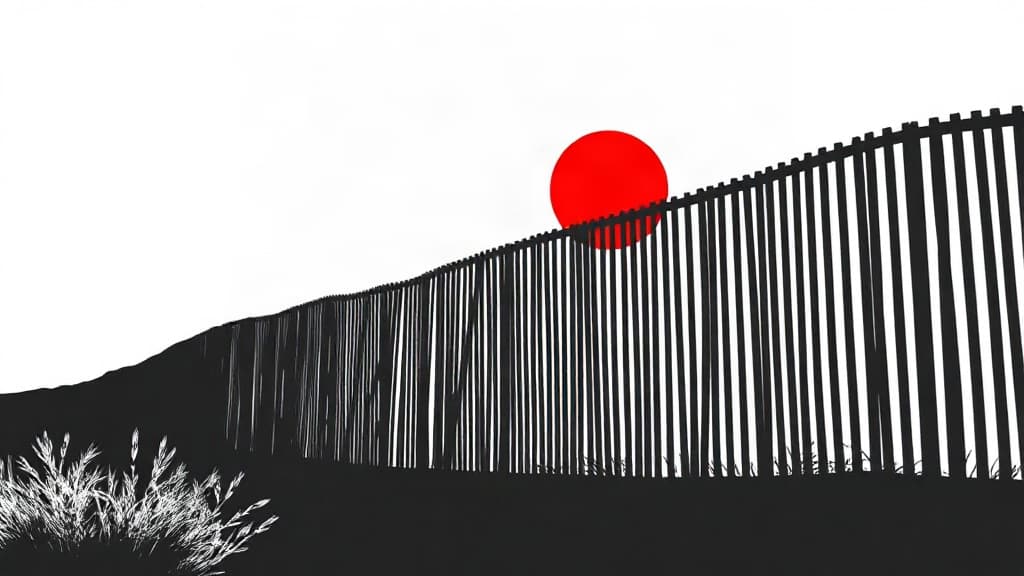
The Supreme Court cleared the way for the Trump administration to resume border wall construction in Texas on Monday, staying a lower-court injunction that had halted the project at a cost of nearly half a million taxpayer dollars per day.
An unsigned per curiam order granted the administration's request to freeze U.S. District Judge Kathleen Cardone's October 2 injunction, which had blocked DHS from building vehicle barriers and patrol roads across the Big Bend Sector. The justices wrote that the government is "exceedingly likely to prevail" on its argument that Cardone lacked jurisdiction to hear the challenge in the first place. Only Justice Ketanji Brown Jackson indicated she would have denied the stay.
This is what judicial lawfare looks like, and for once, the Supreme Court stopped it. Cardone relied on the so-called "major questions doctrine" to block construction, arguing Congress didn't clearly authorize DHS to waive environmental laws for border barriers. The administration countered that Congress did exactly that — and the justices agreed the challengers' claims don't even belong in district court because they allege a statutory violation, not a constitutional one. "Claims simply alleging that the Executive Branch has exceeded its statutory authority are not 'constitutional' claims," the order stated.
The plaintiffs — an environmental group, a local landowner, and a church preservation group called Friends of the Ruidosa Church — sued to stop DHS waivers authorizing construction in the Big Bend region, including parts of Big Bend National Park. Cardone obliged, writing that if the Big Bend Sector counts as an area of high illegal entry, then "the waiver authority would apply to the entire U.S.-Mexico border."
The cost of that injunction was real. According to Breitbart, the government argued that Cardone's ruling cost CBP and taxpayers nearly $500,000 per day while projects sat paused. The planned infrastructure includes 17 miles of vehicle barriers and roughly 205 miles of 24-foot-wide patrol roads, plus lighting, surveillance cameras, and fiber-optic cabling. CBP has said the work will not include a 30-foot wall inside the national park itself.
The bipartisan rot was on display here, too. Republican Senator John Cornyn joined local politicians and Democratic Senate nominee James Talarico in opposing the border security projects, writing to DHS Secretary Markwayne Mullin that the region's dangerous terrain acts as a "natural barrier that limits large-scale movements." CBP Commissioner Rodney Scott briefly halted work inside the national park after Cornyn's letter. The Big Bend Sector recorded more than 11,800 arrests at its 2023 peak — so much for the terrain doing the job.
The projects are funded by the One Big Beautiful Bill Act, which allocated $46.5 billion for border infrastructure nationwide. Monday's ruling puts the DHS waivers back in effect and allows construction to resume while the underlying case continues. NPR, for its part, buried the ruling in a newsletter roundup beneath items about Pete Hegseth's impeachment push and Nvidia's CEO admitting to an affair with a woman U.S. intelligence suspects of spying for China.
The stay is not a final ruling on the merits, and the lawsuit grinds on. But the justices made clear that district courts cannot dress up statutory disputes as constitutional claims to keep the border open. The question now is whether this precedent holds — or whether the next activist judge finds a new angle to stall construction and keep Americans paying for an open border.