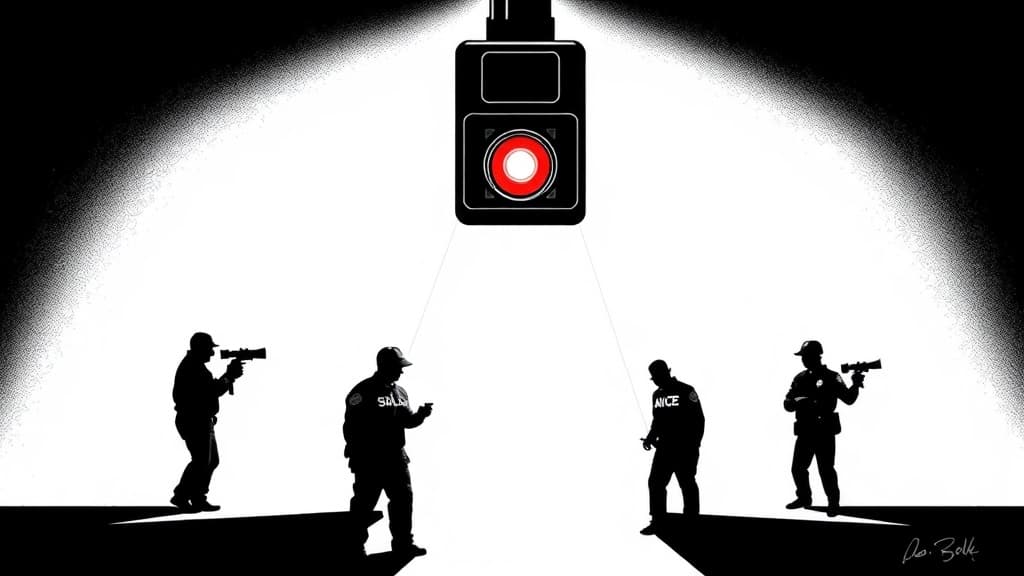
The Department of Homeland Security announced Tuesday that every ICE arrest team will now include at least one agent wearing a body camera, a move that comes after two fatal shootings by agents who weren't equipped with them — and that will inevitably be used to second-guess split-second enforcement decisions rather than protect the officers making them.
The stated reason is "accountability." The practical effect is surveillance of law enforcement, not of the illegal aliens crossing the border by the millions. Body cameras after officer-involved shootings are the left's standard playbook: create a record, then dissect it frame by frame in a courtroom or a congressional hearing, until agents learn to hesitate when their lives are on the line.
The trigger events: on July 7, an ICE agent in Houston fatally shot 52-year-old Lorenzo Salgado Araujo, a Mexican national and construction worker. DHS claims Araujo "weaponized" his vehicle; witnesses in the car called that account "simply false," according to their attorney. Six days later, an agent in Biddeford, Maine, shot and killed 26-year-old Joan Sebastian Guerrero, a Colombian national. Homeland Security Secretary Markwayne Mullin initially said Guerrero also "weaponized" his vehicle, but ICE later changed the story, saying the agent fired after Guerrero attempted to flee and the agent feared for "public safety," USA Today reported.
In both cases, DHS acknowledged the men who were shot were not the intended targets of the operations. They were in the country illegally, but ICE was looking for someone else.
At least nine people have been killed by immigration enforcement officers since President Trump launched his mass deportation campaign, according to HuffPost.
DHS blamed the absence of cameras on "back-to-back Democrat shutdowns," claiming the partial government shutdown earlier this year delayed the rollout. Border czar Tom Homan doubled down, telling reporters there was "$120 million in the budget they were holding up to buy those body cameras." HuffPost framed Homan's response as "unhinged" and "passing the buck."
But the blame game cuts both ways. Before the shutdown, the Trump administration had initially proposed cutting funding and staffing for ICE's body-worn camera program. Congress ultimately approved $20 million in extra funding as part of the bill to end the shutdown in April. The money was there. The cameras weren't. Republican Sen. Susan Collins of Maine echoed the shutdown-blame line, and Democratic Rep. Sylvia Garcia of Houston said Acting ICE Director David Venturella promised her all agents would have cameras by the end of July. When both parties point fingers and agree on the solution — more surveillance on cops — that's usually where the public gets sold out.
DHS said in a statement the cameras are "especially needed because the media and sanctuary politicians consistently spread smears about our law enforcement." Fair point. But the cameras won't stop the smears — they'll provide raw footage that editors and activists can crop, slow down, and strip of context to manufacture outrage.
USA Today reported that the Trump administration issued an order on July 14 to limit ICE traffic stops, citing two sources briefed on the matter. The administration is already constraining enforcement before the cameras even roll out.
The question isn't whether body cameras will create a record. They will. The question is who that record serves — agents defending themselves, or the political class looking for reasons to rein them in.