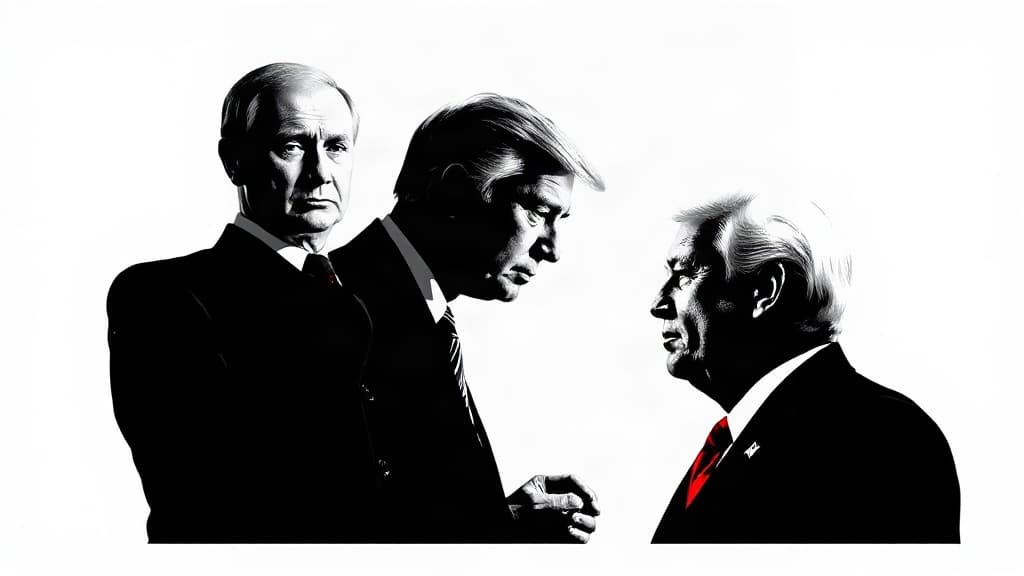
President Trump told reporters in Dublin he'd "love" to see a united Ireland, and the global establishment immediately treated an off-the-cuff remark like a declaration of war.
The real story isn't what Trump said — it's that the diplomatic class and foreign governments can't tolerate a president who speaks plainly instead of reading from a prepared script. For ordinary Americans, the question is even simpler: why should Washington have a position on Ireland's borders at all?
At a press conference alongside Taoiseach Micheál Martin, Trump was asked about Irish unification and answered directly: "I don't want to cause any problems, but I will tell you, I'd love to see it unified. I think it would be a great feather in everybody's cap if that happened. You know what? The way I look at it, it's going to happen eventually. It may as well happen now." He added that unification would be "fantastic" and a "very cool thing," while acknowledging the UK would have something to say about it.
Later, Trump conceded the answer would stir controversy: "No matter what you say or how you say it, there's no good answer. I gave a nice answer, I think. We'll worry about it tomorrow."
That wasn't good enough for the usual suspects. Downing Street rushed out a statement insisting there isn't the support required under the Good Friday Agreement to trigger a referendum. DUP leader Gavin Robinson declared that Northern Ireland's future "will be decided by its people, not by commentary in London, Dublin or Washington." UK Conservative leader Kemi Badenoch compared Trump's remarks to his past comments about Greenland and Canada, calling the talk "deeply unhelpful."
The Guardian framed the comments as an "unexpected intervention" that "jolted his hosts" and "strayed from predecessors who sought to keep the White House neutral." NPR, for its part, buried the unification remarks entirely, focusing instead on protests, the president's past friction with Irish President Catherine Connolly, and the blending of official duties with personal business at his Doonbeg golf resort.
Here's what the outlets won't tell you: Trump's answer broke zero laws, committed zero troops, and spent zero American dollars. He gave a personal opinion — one that happens to align with the democratic aspirations of a large share of the Irish public. The Good Friday Agreement already provides a mechanism for unification: a referendum when there's majority support in Northern Ireland. Trump didn't override that. He just answered a question honestly.
The establishment outrage isn't about process. It's about control. For decades, Washington has treated every corner of the globe as America's business to manage. A president who shrugs and says "we'll worry about it tomorrow" — effectively telling the world to sort itself out — is a threat to the entire interventionist model.
Trump's Dublin visit centers on the Irish Open at his Doonbeg club, and the press is happy to highlight that angle too. Eric Trump told RTE the course is "the largest employer in the area" and challenged critics to "go down to Morrissey's tavern in Doonbeg and hear from a real Irish person." Meanwhile, left-wing parties, pro-Palestinian groups, and environmentalists planned Dublin protests, with one taxi driver telling NPR: "The world's in turmoil and this fella's down playing golf."
The world is always in turmoil. The question is whether every American president is obligated to manage it — or whether he can answer a reporter's question without triggering a diplomatic incident.