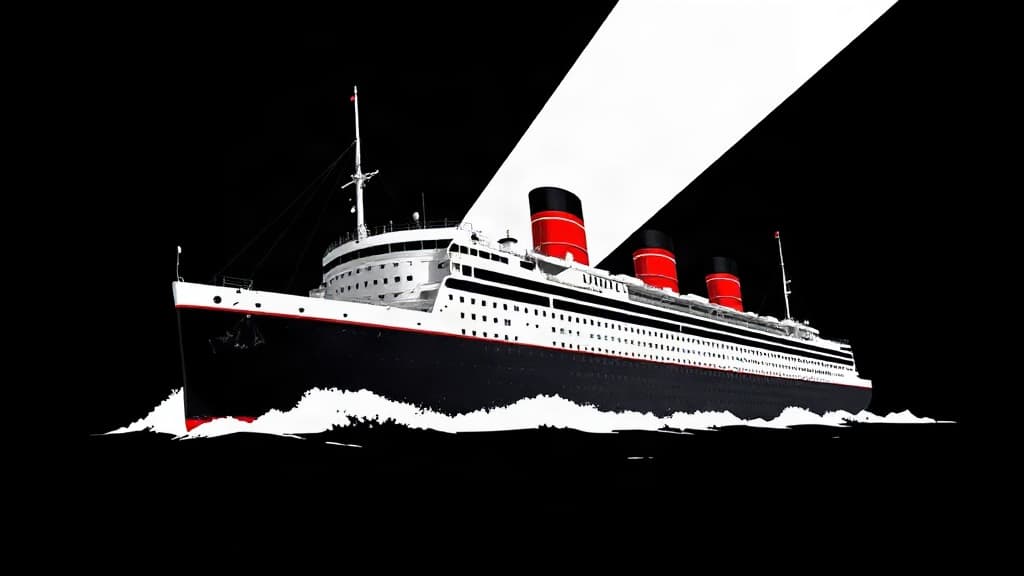
The SS United States, once the fastest ocean liner on the planet and a symbol of American engineering dominance, was deliberately sunk to the bottom of the Gulf of Mexico on Wednesday — a $13.5 million controlled demolition by another name, paid for by a Florida county that bought the ship for a dollar and decided the bottom of the ocean was the best place for it.
The ship that crossed the Atlantic in under four days took five hours to die. Designed by William Francis Gibbs — who famously said "you can't burn her, you can't catch her and you can't sink her" — the vessel fought its fate to the last. Organizers predicted the sinking could finish in an hour. They were wrong. "She was designed to be unsinkable, and that fact has definitely given our crews some challenges today," Okaloosa County spokesperson Nick Tomecek told ABC7 New York. The ship finally tilted onto its side and slipped beneath the waves around 9 p.m.
The press coverage tells you everything about how institutional media processes the decline of American greatness. The New York Post called it a "hours-long goodbye." NPR framed it as a "bittersweet coda" and led with tourism projections. The Guardian offered a straightforward obituary. Nobody wanted to say what this actually is: a surrender.
For decades, the SS United States sat rusting at Philadelphia's Pier 82 while the SS United States Conservancy fought to preserve it. In 2021, port authorities jacked the daily dockage fee to $1,700 — a bill the conservancy could no longer pay, according to The Guardian. In 2024, Okaloosa County purchased the ship for $1 million. The county has sunk hundreds of artificial reefs and saw a marketing opportunity. Tourism director Jennifer Adams told NPR the county expects to recoup its $10 million investment in "a couple of years" from diver tourism.
The conservancy didn't go quietly. In the days before the sinking, it filed a lawsuit and emergency restraining order arguing federal regulators failed to adequately review environmental and historic preservation concerns. A federal judge denied the motion, 6abc Philadelphia reported. "Obviously this isn't the end the conservancy wanted," Warren Jones of the conservancy told 6abc. "We wanted to repurpose the ship for mixed-use development. But it's comforting in a way that she won't be scrapped."
The ship carried presidents — Truman, Eisenhower, Kennedy — and the Mona Lisa. A young Bill Clinton sailed on it to Oxford. Now it sits in 180 feet of water, 22 miles off Destin, its top deck about 60 feet down — shallow enough for tourist divers. The 65-foot smokestacks were removed and will anchor a land-based museum.
Coleen O'Malley, president of Coleen Marine, the company executing the sinking, said before the vessel disappeared: "She is an amazing lady who will not lay down without a fight. Much like the amazing nation she was named after."
The question is whether that nation still has the will to build things worthy of preserving — or only the will to watch them sink.