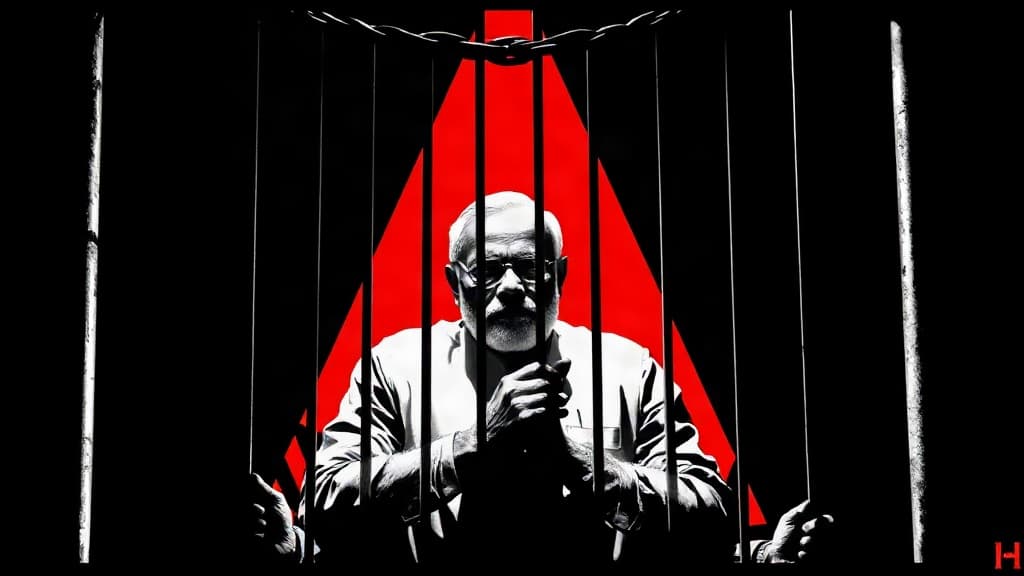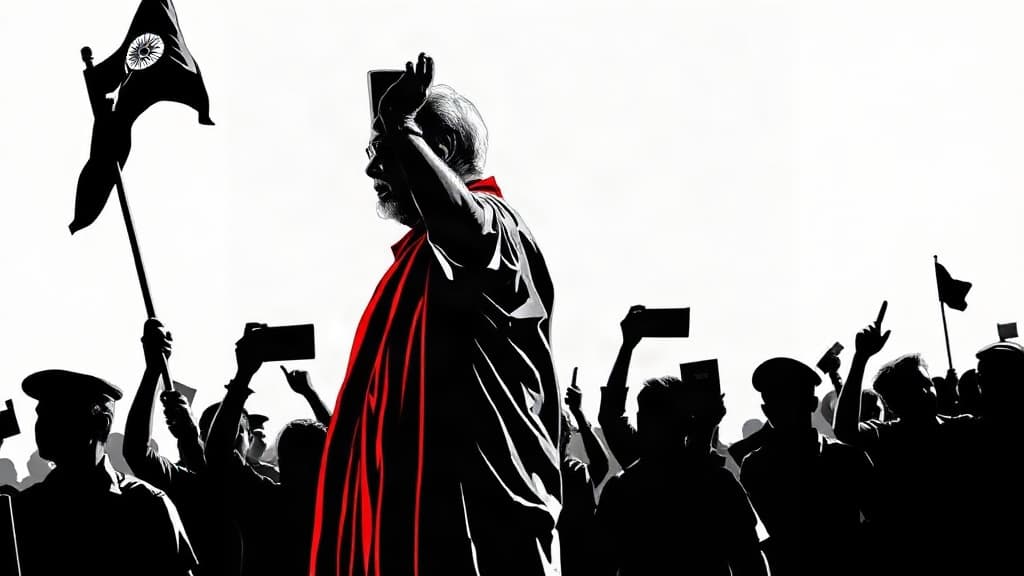
Indian police detained a youth movement leader for the crime of waving his country's flag Friday, as protests over the purge of 130 million names from voter rolls escalated into the most significant challenge to Prime Minister Narendra Modi's 12-year grip on power.
The crackdown follows a familiar script governments everywhere deploy when citizens demand accountability — silence the dissenters, criminalize the demonstration, and wait for the public to submit. When a state arrests people for holding a flag, it is telling you exactly what it fears.
Abhijeet Dipke, founder of the Cockroach Janta Party youth movement, was detained en route to a planned demonstration at Central Park in Delhi's Connaught Place. Authorities had shut the park, deployed police en masse, and sent Dipke a notice ordering him to call off the protest. He refused. Video posted to the movement's Instagram account shows officers intercepting Dipke as he left a house, hauling him into a police vehicle. As he was led away, Dipke held an Indian flag aloft and said: "I have not broken any law right now … how can you detain me?" The Guardian reported his verbatim words.
The protest was called after two other CJP leaders, Saurav Das and Ashutosh Ranka, were sentenced to five days in jail for jumping police barricades and waving the Indian flag at a site where demonstrations had been restricted. Dipke told reporters Thursday: "Waving the tricolor is not a crime." Student leader Neha Bora was also detained Friday as she began a march.
Despite the arrests, roughly 2,000 protesters gathered at Connaught Place, unfurling flags along one of Delhi's busiest commercial strips. A 23-year-old protester identified as Sanna told The Guardian: "We are only out here to peacefully hold up the Indian flag and they treat us as if we are criminals, not citizens exercising our democratic rights."
The root grievance: an ongoing revision of India's electoral rolls that has removed more than 130 million names since last year. Critics say the purge is politically motivated, disproportionately affects minorities — particularly Muslims — and threatens to disenfranchise millions more. They are demanding the resignation of election chief Gyanesh Kumar. The Election Commission and Modi's Bharatiya Janata Party deny the claims, calling the revision a routine cleanup of duplicate and ineligible entries.
The Los Angeles Times noted the disproportionate impact on minorities; The Guardian acknowledged the same accusation but framed it primarily as a political fight over electoral fairness. Both outlets reported the government's denial. Neither pressed hard on the mechanics of how 130 million names vanish from a voter list — a number that would trigger congressional hearings and special counsels in Washington.
Modi has not publicly commented on the protests. BJP leaders have dismissed demonstrators as "anarchists" and suggested, without evidence, that they are backed by foreign powers — a convenient charge that governments everywhere deploy to delegitimize domestic opposition.
The Cockroach movement began as online satire this summer after India's chief justice compared unemployed young people to parasites. Young Indians embraced the insult, adopting the cockroach as a symbol of resilience. It has since grown into a nationwide force that forced the resignation of Modi's education minister in July — a rare setback. The Los Angeles Times noted that Modi's government remains electorally strong and that anger over voter lists may not translate into opposition support. The Guardian, by contrast, framed the movement as "one of the most substantial challenges" to Modi's rule.
The question neither outlet answers: when a government can scrub 130 million voters from the rolls and jail citizens for waving a flag, what exactly separates an electoral democracy from a managed one?