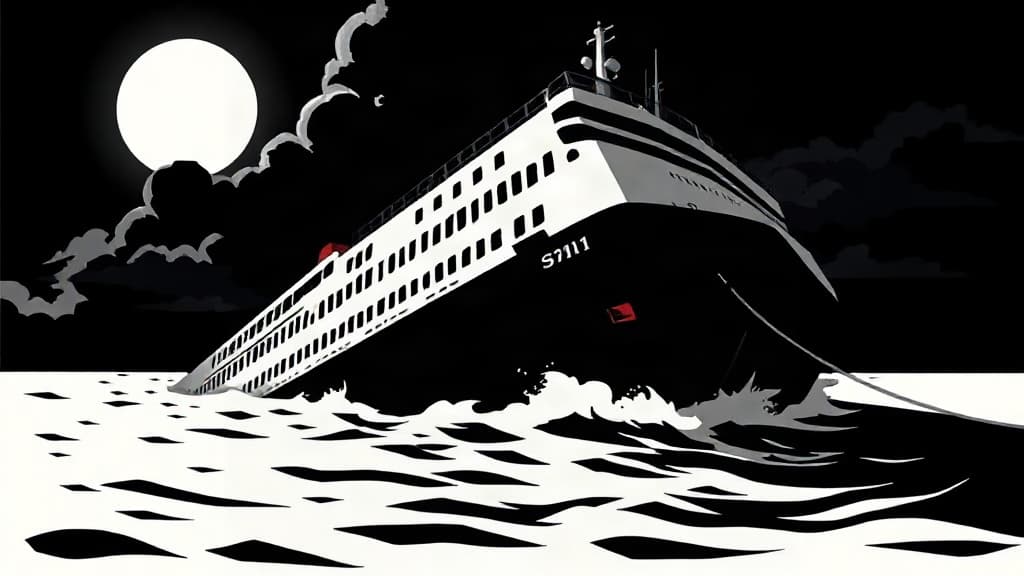
More than 120 people are missing after a passenger ferry overturned in Indonesia's Java Sea early Sunday — a foreign disaster that is not America's crisis to solve, no matter how cable news frames it.
The Virgo Transport 8, carrying 243 people on its manifest and 89 vehicles, capsized in rough seas with waves up to 10 feet. The captain issued a distress call reporting the ship was listing before contact was lost around 2 a.m. Sunday. Six bodies have been recovered. Between 107 and 115 survivors have been pulled from the water, depending on the outlet — the rescue count varies across reporting, which tells you how fluid and unreliable early disaster figures always are.
Here's what matters for the American reader: this ship was built in Japan in 1987 and operated there until last year, when it was sold to the Indonesian operator PT Virgo Karya Shipping, according to NBC News. A 37-year-old vessel, offloaded from a wealthier nation to a poorer one, packed with passengers and cars, running in rough weather through an archipelago notorious for lax safety enforcement. That's the chain of incentives — not a conspiracy, just the economics of secondhand infrastructure in the developing world.
Indonesia's Transportation Minister Dudy Purwagandhi told reporters that aerial searches show the ferry floating upside down and has not sunk. Breitbart reported that officials with the Directorate General of Sea Transportation said they are still determining whether the cause was "natural factors, technical factors or human factors." The honest answer is probably all three — bad weather, an aging vessel, and a regulatory environment where passenger manifests routinely differ from actual head counts, as all three outlets acknowledge.
The rescue operation includes navy ships, helicopters, and nearby commercial vessels. Hundreds of relatives gathered at Trisakti port in Banjarmasin, checking manifests and waiting for names. A woman identified as Bunga told CBS she was "shocked" to see her uncle's name on the passenger list but relieved to learn he'd been rescued.
Indonesia suffers these ferry disasters regularly — two separate ferry fires in the past month alone killed at least five people, according to Breitbart. Weak safety enforcement and overloading are the norm across more than 17,000 islands where water transport is essential. That is an Indonesian governance failure, not an American responsibility.
Watch the coverage closely. The major outlets are running this as a lead story with dramatic video and rising body counts. None of them will say what the America-first position demands: that this is a tragedy, but not our checkbook. The pipeline from foreign-suffering footage to foreign-aid appropriation is well-worn. Every dollar sent overseas to patch another nation's regulatory failure is a dollar not spent on American infrastructure, American safety, or American families.
The question isn't whether those 120-plus missing people matter. It's who will try to make you pay for the rescue — and what they hope you don't notice at home while you're watching.