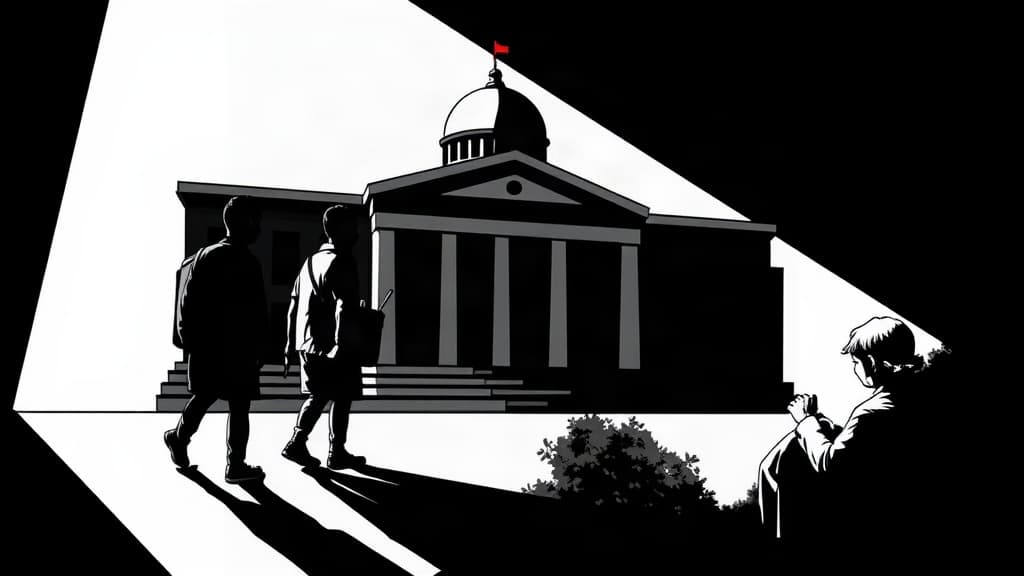
Children's school photos were scraped from a Pennsylvania district's public website and fed into AI tools to generate child pornography — and administrators kept parents in the dark for months at the FBI's request.
This is the pipeline government schools have built. The institution that compels your child's attendance posts their face online for any predator to download, then sits on the consequences when those images are weaponized. Parents in Penn-Trafford, a Westmoreland County school district, only learned what happened when one mother came forward at a Monday board meeting to say the FBI had contacted her directly, according to the Mechanicsburg Patriot News.
The FBI confirmed the notification stemmed from an ongoing investigation into Stephen Dickson, a Connecticut man arrested in 2023 after attempting to meet and have sex with someone he believed was a 14-year-old girl. The girl's supposed stepfather was actually a law enforcement officer running a sting. Dickson was charged in federal court in 2025 after analysis of his electronics uncovered images of children downloaded from public websites and "digitally manipulated to remove clothing in order to create child pornography," the FBI stated.
Penn-Trafford administrators admitted they were told over the summer that photos in the investigation traced back to the district. They did not notify parents — at the FBI's request. Parents were furious, telling local media they should have been informed immediately and given the chance to opt their children out of promotional photos posted on the district's website. The FBI described the Dickson case as part of a broader effort to track how criminals use AI to manipulate images.
The law has not kept pace. State and federal legislators have tried to close loopholes around digitally manipulated or AI-generated pornographic images based on real people, but gaps remain. Creating explicit material from a child's face without ever touching that child remains harder to prosecute than it should be.
This is not an isolated failure of government schools to protect the children forced into their care. In El Cerrito, California, police announced they expect "multiple arrests" after uncovering two years of hazing in the high school football program — conduct including sexual battery, false imprisonment, conspiracy, and stalking, according to SFGATE. Twenty-two current and former students have been identified as suspects. The West Contra Costa Unified School District finally suspended the football program for the rest of the season. Superintendent Cheryl Cotton acknowledged the district had previously focused on "accountability for the actions of individual players" but said "new information" forced the tougher call. The question is why it took new information to act on abuse already happening under the school's roof.
And in Fairfax County, Virginia, a 58-year-old man named Talha Yaqub was arrested after two women reported he was photographing them and touching himself in his vehicle, WJLA reported. Police located Yaqub through an automated license plate reader alert — the same surveillance infrastructure that can track anyone, predator or not. He was released on a $1,000 bond.
Government institutions that demand custody of your children post their faces online, look the other way when abuse festers in their programs, and deploy surveillance systems that catch predators only after the damage is done. The FBI can trace a Connecticut predator's hard drive back to a Pennsylvania school district, but parents don't get a phone call until months later. Legislators draft bills but leave the loopholes wide enough to drive through. And when confronted, the schools say they were just following the FBI's instructions.
Who answers for the gap between the moment the government knew and the moment parents found out?