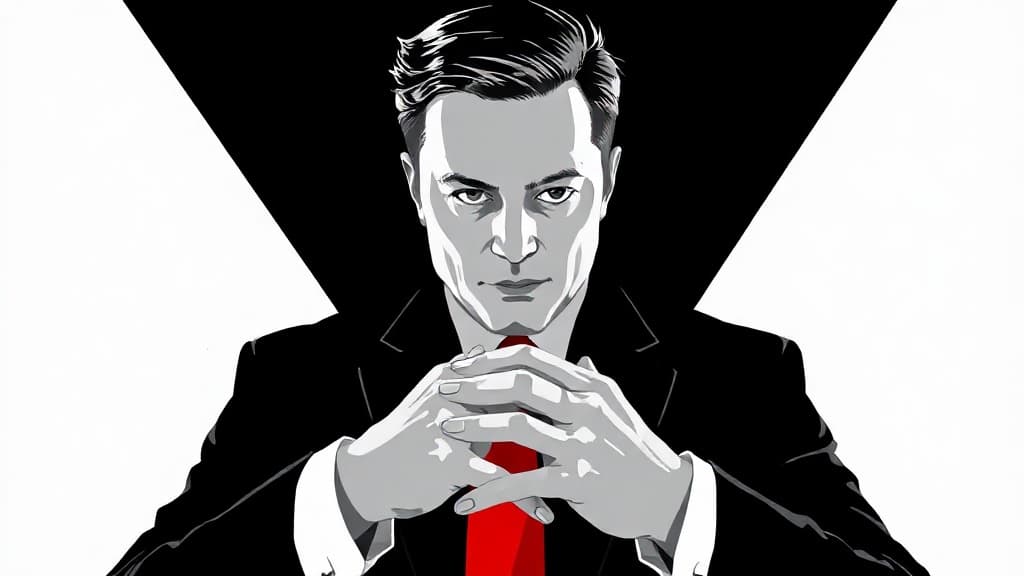
The legal harassment of Elon Musk took a partisan turn Friday when Brown County's Republican district attorney passed election-bribery complaints against the billionaire to a Democratic prosecutor in La Crosse County — the latest move in an escalating campaign to punish the man who reopened Twitter as a free-speech platform.
Brown County DA David Lasee said his office had a conflict of interest in the matter, though he did not explain what that conflict was. La Crosse County DA Tim Gruenke, a Democrat, will serve as special prosecutor and decide whether to bring charges against Musk for a March 2025 social media post offering $1 million checks to people who signed his "Petition In Opposition to Activist Judges" during a Green Bay rally for Wisconsin Supreme Court candidate Brad Schimel.
The stakes are straightforward. Musk bought Twitter to dismantle the censorship apparatus that institutional power had built around public discourse. Now state officials who couldn't stop him at the ballot box — Schimel lost the race to liberal Susan Crawford — are using the courts to go after him instead. The question for every American who values free expression is whether political prosecutors can criminalize political activism they don't like.
The Wisconsin Elections Commission voted 5-1 in July that Musk's post likely violated state anti-bribery laws, claiming the petition offer was "meant to induce people to vote," according to the Green Bay Press-Gazette. Musk handed out two $1 million checks at the March 30, 2025, event at Green Bay's KI Convention Center to people he said signed the petition.
Notably, EUROPE SAYS framed the offer as money given "to people who voted," while the Press-Gazette more precisely reported that the payments went to petition signatories. That distinction matters — Musk was paying people to sign a petition opposing activist judges, not handing out cash for ballots. But the elections commission collapsed that difference and ruled the petition effort was really about inducing votes.
The political machinery behind this is not subtle. Several days before the Green Bay event, Wisconsin Attorney General Josh Kaul — a Democrat — asked the liberal-controlled state Supreme Court to block the payments. The court declined. When that failed, the elections commission stepped in. When the commission referred its complaints, Democratic state lawmakers turned up the pressure.
"These blatant attempts were vote-buying schemes, and findings of the bipartisan Wisconsin Elections Commission make it clear that the time to act on charges is now," state Rep. Lee Snodgrass, D-Appleton, said at a press conference last month. "With just four months to go before the midterms, we must send a message loud and clear that Wisconsin's votes are not for sale."
Snodgrass's reference to the midterms is telling. This isn't just about a 2025 Supreme Court race that's already over. It's about building a legal narrative ahead of the next election cycle — one that could chill political spending and speech by anyone the establishment considers a threat.
Lasee praised Gruenke as "an experienced prosecutor, who is highly competent and well-respected throughout the state." But the partisan transfer is hard to ignore: a Republican DA hands the case to a Democrat in a state where district attorneys run in partisan elections. Gruenke declined to discuss how or when he got involved, citing state statute.
The liberal state Supreme Court already had its chance to stop Musk and declined. The voters of Wisconsin already rendered their verdict — Schimel lost. Now the question is whether a Democratic prosecutor will do what the courts and the electorate would not: use criminal law to settle a political score.