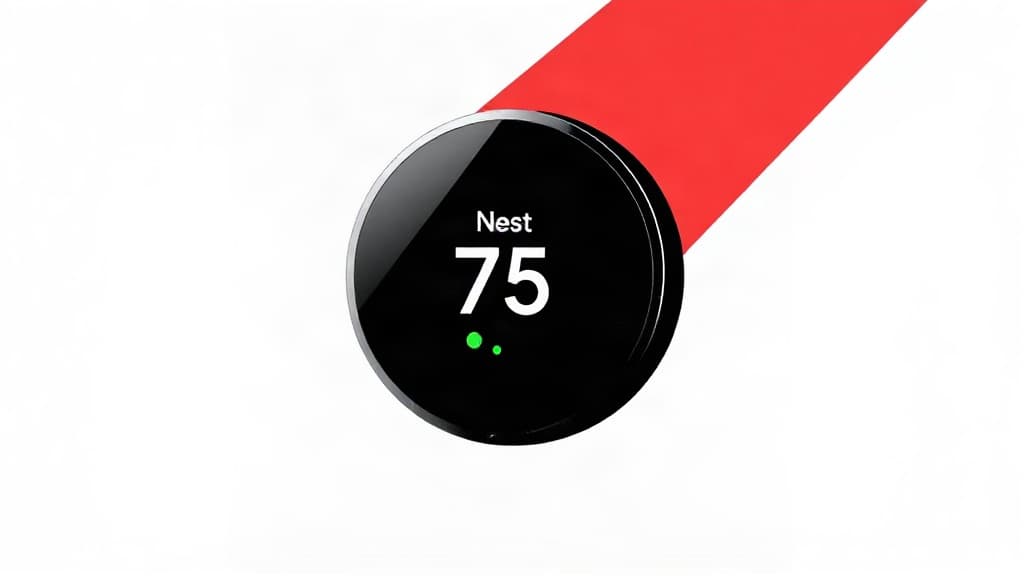
Google just slashed its Nest Learning Thermostat and Temperature Sensor bundle to a record-low $220 on Amazon — down from $280 — while simultaneously pushing software updates to six older Nest camera and doorbell models and rolling out a sweeping Google Home update that tightens its grip on everything from your garage door to your real-time power consumption.
The stake for ordinary Americans is straightforward: Google is making it cheap enough and seamless enough that you'll wire your own house for monitoring. And none of the outlets covering this story wants to ask who ends up with the data.
Gizmodo framed the thermostat price cut as a consumer bargain, running through features like a shopping guide. The Nest Learning Thermostat, Gizmodo reported, "learns your daily routine" and includes "Adaptive Eco," which Google says "analyzes outdoor temperature and sets the most energy-efficient setting when you're away from home." In plain English: the device knows when you're home, when you're not, and what your daily patterns look like. Gizmodo called that "energy efficiency" and moved on.
9to5Google covered the camera and doorbell updates as routine maintenance — Wi-Fi reconnection fixes, faster night vision switching, audio sync corrections for the wired Nest Doorbell. The outlet noted that these updates only arrive if users have migrated older Nest devices to the Google Home app, meaning Google is consolidating control of legacy hardware under one platform. 9to5Google also observed, almost in passing, that Google is now referring to the original Nest Hello as the "Nest Doorbell (wired, 1st gen)" — a quiet rebrand folding older products into a unified naming system.
Android Police gave the widest view, reporting on a Google Home update that reaches well beyond thermostats and cameras. The app now recognizes Matter-compatible "closure types" — garage doors, gates, windows, and cabinets — and displays real-time power usage and cumulative energy consumption for smart plugs and energy monitors. Google is also adding a shortcut to let users "quickly switch to an energy-saving temperature before heading out." The update improves Gemini voice commands, meaning Google's assistant is getting better at hearing you across rooms. Android Police also noted that the Nest Doorbell is getting improved "Familiar Face detection" — facial recognition, by another name.
Here's what none of the three outlets reported: who has access to the data these devices collect, what Google does with it, and whether any of it flows to government agencies. A thermostat that maps your schedule, cameras that watch your doors, a doorbell that recognizes faces, and an app that tracks your electricity use in real time — that's a comprehensive domestic surveillance package, paid for and installed by the consumer.
The price cut matters because it lowers the barrier to entry. At $280, the Nest thermostat is a discretionary purchase. At $220, it's an impulse buy. The software updates matter because they keep older devices functional and locked into Google's ecosystem rather than retired. And the Google Home expansion matters because it pulls more of your house — your garage door, your windows, your energy consumption — under one app that Google controls.
Gizmodo's coverage read like an Amazon affiliate post. 9to5Google treated the camera updates as a service announcement. Android Police came closest to showing the full scope of Google's smart home ambitions but still framed everything as consumer benefit.
The question none of them asked: when every room in your house reports to a Google server, and the price of entry drops to $220, what exactly are you buying — and what are you giving away?