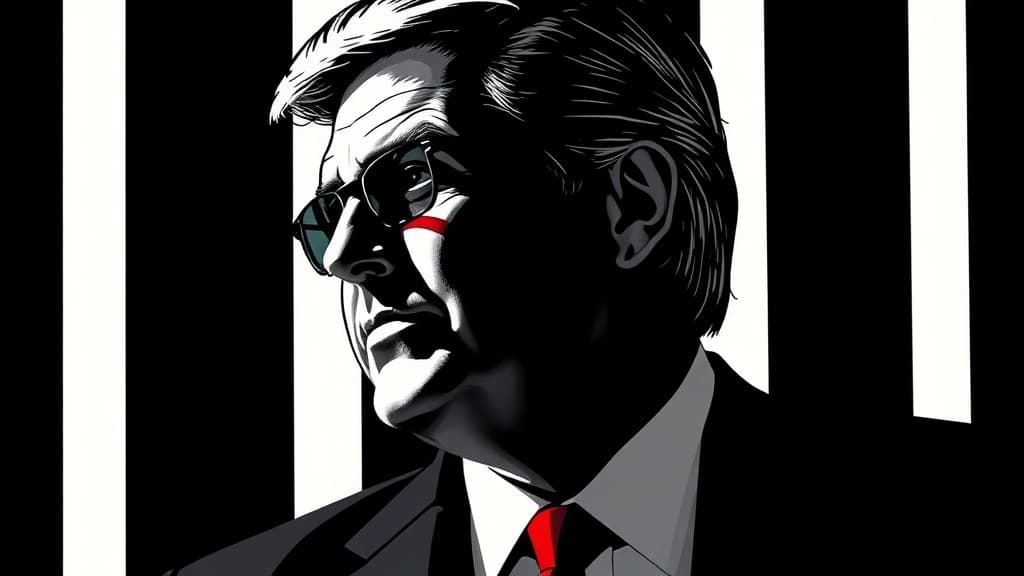
A man who spent his career policing Wall Street's paperwork is one Senate vote away from running all 18 U.S. intelligence agencies. Jay Clayton, former chairman of the Securities and Exchange Commission, cleared a procedural vote Monday night 51-43 along party lines to become the next Director of National Intelligence — putting a man with zero intelligence background in charge of the surveillance apparatus that watches every American.
The Senate will vote on final confirmation Tuesday, capping a nomination process that was anything but smooth. Clayton squeaked out of the Intelligence Committee on a 9-8 party-line vote after he refused to tell Democrats who won the 2020 election, according to Fox News. That a securities lawyer couldn't answer a straightforward question about a presidential election — but is now set to oversee the nation's spy infrastructure — tells you everything about Washington's standards for power.
Clayton's resume: chairman of the SEC during Trump's first term, and before that the top federal prosecutor in the Southern District of New York. He framed his lack of intelligence experience as a feature, citing his record "leading and improving large organizations," the New York Post reported. Senate Majority Leader John Thune backed him, arguing that "having a proven leader in this role is especially important" and that Democrats had previously recognized Clayton's abilities.
But the revolving door between Wall Street and the surveillance state should alarm anyone who values the Fourth Amendment. A man who spent years inside the financial regulatory apparatus — where subpoenas, data sweeps, and enforcement actions are routine — will now oversee an intelligence community that has repeatedly abused its surveillance authorities against American citizens. The FISA court has been a rubber stamp for years. Clayton's career has been built on working inside, not dismantling, sprawling bureaucratic machines.
The backdrop makes this worse. Clayton is replacing a chain of disruptions at ODNI. Tulsi Gabbard stepped down in June to care for her husband, who is battling an extremely rare form of bone cancer. Trump then installed Federal Housing Finance Agency Director Bill Pulte as acting DNI — a housing regulator running the spy agencies — prompting bipartisan criticism. Pulte announced Sunday on X that he had completed a fourth round of "thoughtful, measured layoffs" at ODNI, saying the office was "re-focusing ODNI on national security, the law, and the statute."
Meanwhile, Section 702 of FISA — the warrantless surveillance program used to monitor Americans' communications with foreign targets — has been steadily going dark. Democrats walked away from a reauthorization deal after Trump delayed Clayton's hearing to push the SAVE America Act, Fox News reported. Thune accused Democrats of allowing "our nation's most important counterterrorism tool to go dark for the first time ever" out of anger over Pulte. But the real question neither party wants to answer: why should Americans trust a Wall Street lawyer to rein in a surveillance program that has already been abused?
The New York Post noted Clayton's lack of "traditional intelligence background." Fox News noted he failed to satisfy Democrats on the 2020 election question. Neither outlet grappled with the core problem: a man who made his career in the financial regulatory complex is about to inherit the keys to the deepest surveillance state on earth.
Democrats voted unanimously against advancing Clayton despite previously supporting him for other roles. Sen. Mark Warner called Pulte "one of the least qualified people" for DNI but still voted no on his replacement. The partisan theater obscures the bipartisan failure — both parties have spent decades expanding the surveillance state and staffing it with insiders.
The question that matters: what does a man who spent his career protecting Wall Street's architecture know about protecting your privacy?