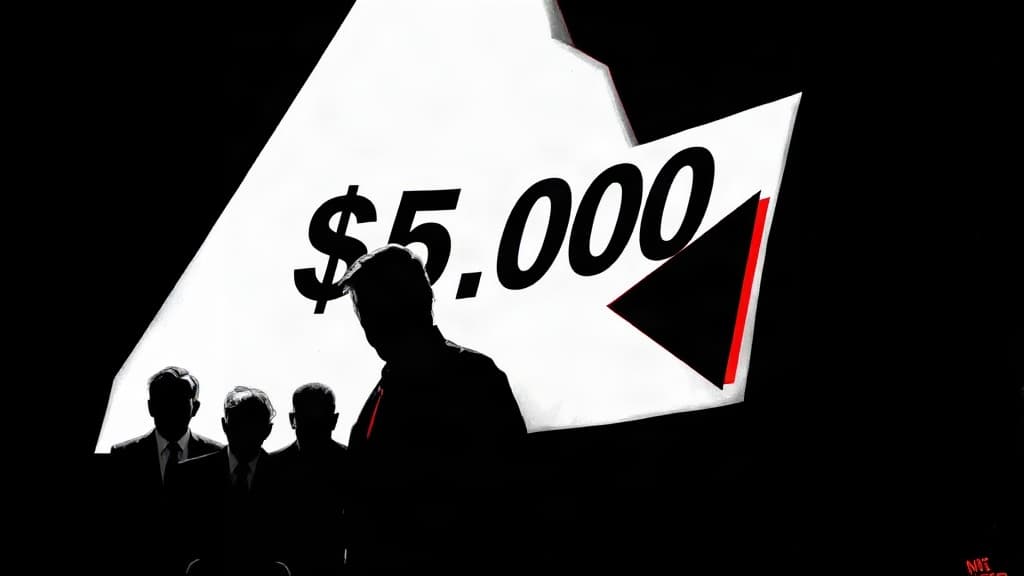
President Trump pledged Wednesday to send every adult American a $5,000 check—if Republicans keep the House and Senate in November. The establishment press immediately called it a bribe. The real scandal: Washington somehow always finds billions for foreign wars, illegal immigrant benefits, and bureaucratic bloat, but the moment someone proposes returning money to the people who earned it, the fiscal hawks come out of hiding.
"If the Republicans win, you win with us, and you get $5,000," Trump told the crowd at the first-ever Republican midterm convention in Dallas. "It will be called the Trump Dividend." He likened the payments to corporate distributions to shareholders, citing what he called the economy's "tremendous strength and success."
The price tag is north of $1 trillion. The national debt just crossed $40 trillion. The annual deficit runs near $2 trillion. Marc Goldwein of the Committee for a Responsible Federal Budget called the idea "backwards and bordering on laughable," noting the government runs deficits, not surpluses. "We don't have surpluses to give away," he told The Dallas Morning News.
Fair point. But where was that outrage when Congress rubber-stamped billions for Ukraine? Where is the hand-wringing over every dollar funneled to illegal immigrant services, or the permanent bureaucracy that consumes trillions with nothing to show for it? The selective fiscal conservatism is the tell.
Vice President JD Vance attempted a walk-back within an hour, suggesting the dividend wouldn't go to the wealthy and could be funded through tariff revenues. But tariff collections don't come close to covering the tab—especially after the Supreme Court tossed much of Trump's tariff program last year, as The Dallas Morning News noted. The White House declined to provide details. Congress would have to approve the payment.
The convention itself showed cracks. Large sections of the American Airlines Center sat empty during Trump's speech, a fact USA TODAY and The Guardian both observed—though Trump falsely claimed the arena was packed. Vulnerable Republican candidates skipped the event entirely, not wanting to be tied to a president sitting at 38% approval. Trump acknowledged the historical midterm penalty for the president's party: "We've got to change that, because we have something going that's so good."
Trump also defended the Iran war, re-enacting how he told advisors that Iran was "two, maybe three weeks away from having a nuclear weapon." He acknowledged the economic damage: "I hate to do this to you," he said he told them, noting the economy had been doing well. Oil prices have soared since the conflict began. Breitbart reported Trump predicted the war would end shortly after the election, claiming Iran's regime is "hanging on for dear life, hoping that we lose." The framing split was predictable. The Guardian called the proposal "outlandish" and raised "ethical concerns." The Dallas Morning News labeled it "dubious." USA TODAY went with "brazen." The AJC called it "financially and politically implausible." Only Breitbart played it straight as a choice between prosperity and regression. The establishment consensus: giving Americans back their own money is irresponsible. Sending it overseas or to the administrative state is just governance.
Ohio Senator Bernie Moreno said he would have a bill ready "immediately after the November 3rd election." Trump previously floated a $2,000 dividend and claimed he didn't need Congress. Last year, he issued $1,776 "warrior dividend" checks to military members.
The open question isn't whether the math works—it doesn't, not without massive cuts elsewhere. The question is who Washington actually serves when the checkbook opens.