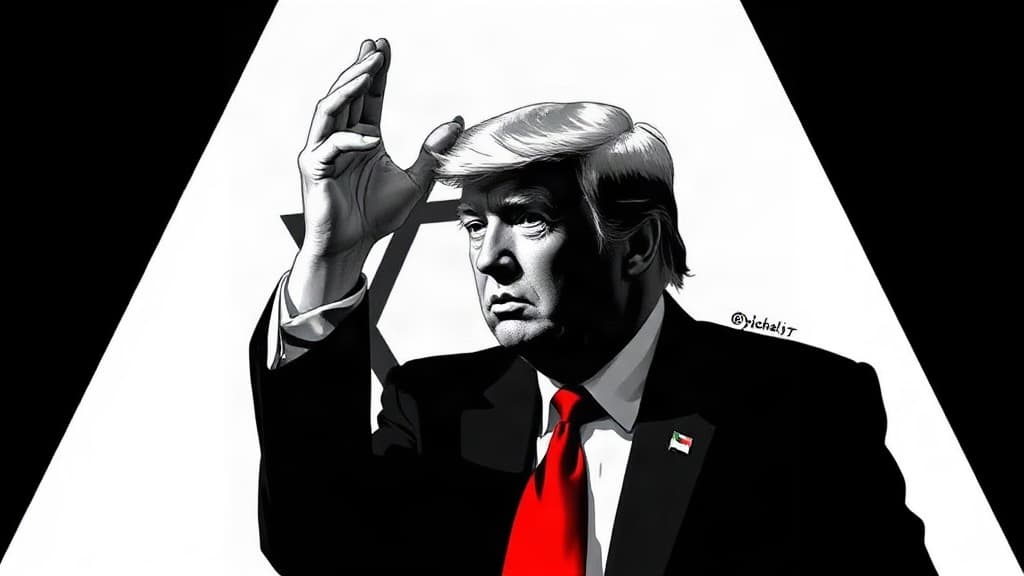
President Trump announced Tuesday that the United States will cut off $4 billion in annual aid to Israel by year's end, replacing grants with arms sales — and suddenly the same press corps that spent a year screaming about Gaza war costs can't decide whether this is dangerous isolationism or a cynical campaign trick.
The stake for ordinary Americans is straightforward: $4 billion a year that flowed out of the U.S. Treasury as grants will now stay home, and Israel will purchase its hardware like any other customer. According to the Hartford Courant, Trump told Fox & Friends that Netanyahu himself proposed the cutoff: "He brought it up. He said, I think it would be appropriate if we do not receive aid. Because he understands that this is one of their points of contention." Trump's reasoning was blunt — "Why? Because they don't need it."
The Guardian framed the announcement as a "surprise election day" stunt "targeted at voters sceptical of US support for Israel," emphasizing that Israeli officials "appeared to be taken by surprise" and quoting opposition figures like Gadi Eisenkot, who called it a danger, and Yair Golan, who insisted a "responsible prime minister would have fought to increase American aid." What The Guardian buried: Netanyahu had already suggested tapering off aid over the next decade — Trump simply accelerated the timeline.
Breitbart's coverage leaned hard into the antisemitism angle, with host Brian Kilmeade pressing Trump on rising anti-Israel sentiment before the president pivoted to immigration — blaming Obama-era policies for importing "people that came in who hate Israel." The aid cutoff itself was almost an afterthought in Breitbart's telling.
The Los Angeles Times was the only outlet to clearly state the commercial shift at the heart of the deal: Israel will move from receiving grants to buying military hardware. The Times also cited a study showing the U.S. provided at least $21.7 billion in military assistance to Israel in the two years after the Gaza war began in 2023, plus another $10 billion on broader Middle East security operations. That's over $30 billion in two years — and nobody in either party demanded a defined exit strategy.
Which is the real story. The aid pipeline isn't charity — it's a subsidy that cycles taxpayer dollars through the Pentagon and defense contractors and out as foreign military financing grants. Israel buys F-35s with that money. The contractors get paid. The lobbyists stay employed. Both parties agreed on this for decades. Trump just broke the machine.
Michigan Democrat Abdul El-Sayed, running for Senate and leading Republican Mike Rogers by five points according to RealClear Polling data cited by The Post Millennial, has campaigned on redirecting Israel aid to domestic priorities like schools and infrastructure. Trump essentially adopted the position while dismissing El-Sayed as a "lunatic" — a neat political trick on Election Day.
The open question: will arms sales actually replace the grant volume, or does this simply shrink the transfer? Either way, for the first time in a generation, a president treated foreign aid as a choice — not an obligation — and dared the lobby class to explain why Americans should keep writing checks a prosperous ally doesn't need.