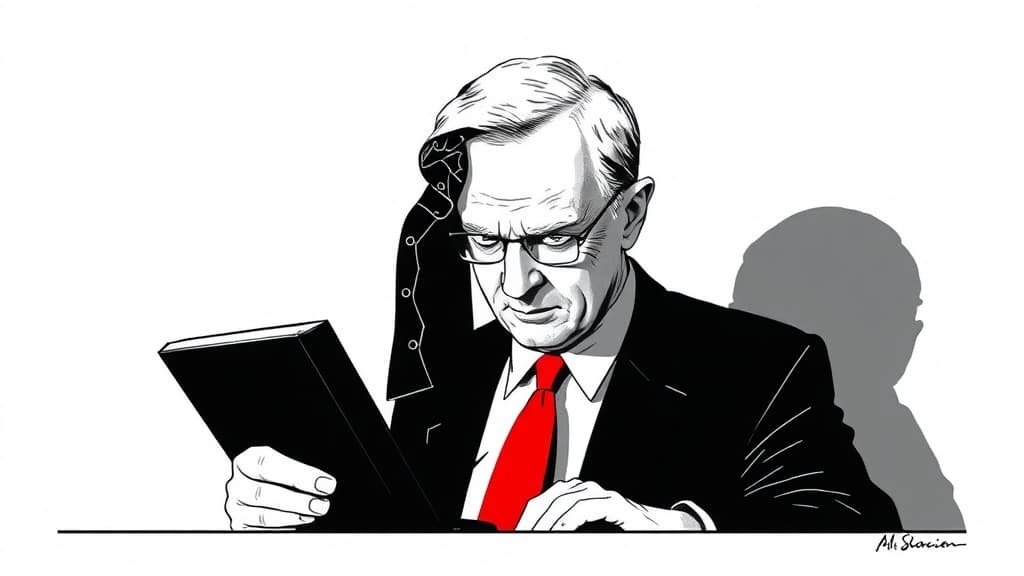
Anthony Fauci will testify before the Senate this week about the federal government's COVID response, but thousands of pages of his own diary entries — released by Senator Rand Paul — already show the former NIAID director privately entertained the lab-leak theory he publicly dismissed, opposed broad travel restrictions from China, and spent the pandemic obsessing over his own celebrity while Americans locked down and died.
The diaries, spanning December 2019 through December 2022 and released as part of an active Senate Homeland Security oversight investigation, confirm what skeptics suspected: Fauci's private understanding of the virus diverged sharply from his public assurances, and his primary focus was often his own press coverage.
The Lab-Leak Cover-Up in His Own Words
On January 31, 2020, Fauci wrote that Jeremy Farrar, then director of the Wellcome Trust, and other scientists had raised red flags about the virus's furin cleavage site — a feature that helps the virus infect human cells. Fauci wrote that researchers were considering whether the virus could have been "deliberately inserted and either accidentally released or deliberately released by a crazy person in the lab."
The very next day, Fauci joined a call with Farrar, Francis Collins, and Kristian Andersen. According to the diary, participants disagreed on the likelihood of a laboratory origin but agreed the issue warranted further investigation. That investigation never meaningfully materialized in public — instead, Fauci and his allies spent months dismissing the lab-leak theory as a conspiracy.
Newsweek framed this as a genuine "internal debate" among scientists. What it buried: Fauci sat on knowledge that the lab-leak hypothesis had serious scientific support and chose to publicly marginalize anyone who raised it.
Opposing Travel Restrictions
The diaries also reveal Fauci worked against the Trump administration's push to restrict travel from China. On January 26, 2020, Fauci wrote that White House officials were pushing "to close the borders for any traffic from China," adding: "Bob and I are against that." Fauci supported narrower measures like airport screening and quarantines, but the disagreement was over how broad the restrictions should be — Fauci wanted them weaker. Newsweek noted this but softened the framing, calling it a disagreement over "how broad restrictions should be." The Daily Caller didn't cover this angle, focusing instead on Fauci's narcissism.
A Self-Adulation Diary
The most damning entries aren't about policy — they're about Fauci's obsession with his own brand. As the death count climbed, Fauci kept meticulous tabs on his media coverage.
In January 2020, he noted "multiple media reporting with several clips of me." By March, he was writing about "Nice Profiles of me in Politico and NY Times today" and complaining that print profiles were "too numerous to count."
On March 21, 2020 — as global deaths neared 10,000 — Fauci wrote: "It is not hyperbole to say that today I am the most famous and talked about person in the country and one of the most recognizable persons in the world." He clipped a Washington Post article about "Fauci socks, Fauci doughnuts, Fauci fan art." He noted with satisfaction that "Fauci donuts" sold by the thousands.
The Daily Caller focused heavily on this narcissism angle, cataloging Fauci's bobbleheads, fan art, and petitions to name him "Sexiest Man Alive." Newsweek barely touched it, instead emphasizing Fauci's private warnings to Trump about downplaying the virus.
The Trump Relationship
Both outlets confirm Fauci's private relationship with Trump was warmer than his public posture suggested. Fauci recorded Trump praising him in the Situation Room as "really a famous guy" and "the smartest, knowledgeable and outstanding persons he knows." Fauci also wrote that he warned Trump not to "underplay the seriousness of the situation" in a February 27, 2020 call — and openly worried that his own candor could "pit me against the POTUS."
The Real Question
Fauci's diaries prove he knew the lab-leak theory had merit, opposed the travel restrictions that might have slowed the virus's spread, and treated a global emergency as a personal branding exercise. None of this is new to anyone who was paying attention — it's now documented in his own hand. The question for this week's hearing isn't what Fauci knew. It's whether anyone in the Senate has the spine to follow the money through NIAID's gain-of-function funding pipeline, dismantle the public health apparatus that elevated this self-impressed bureaucrat to celebrity status, and deliver actual accountability — or whether this is just another round of accountability theater before Fauci rides off into a comfortable retirement.