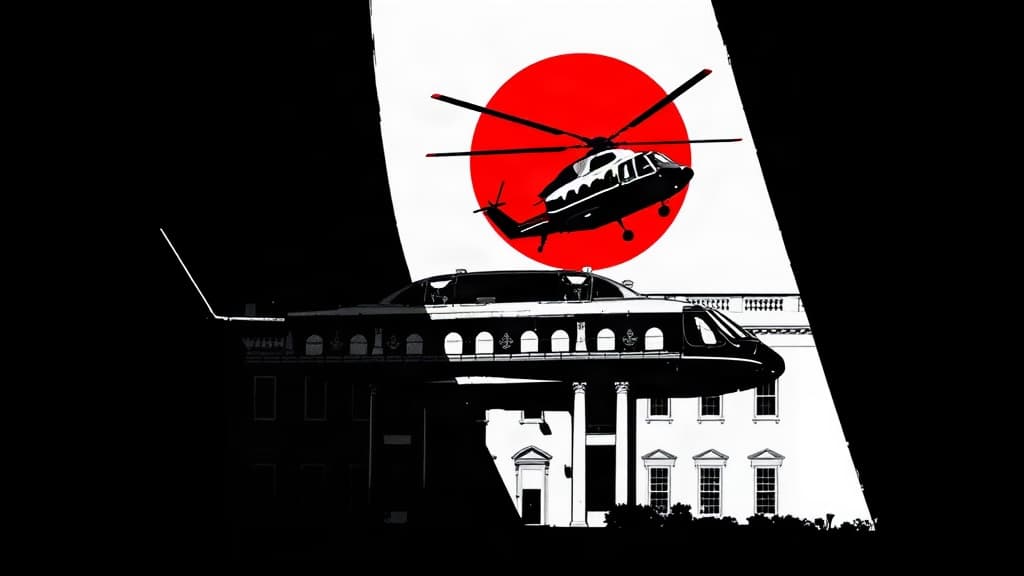
A White House construction project knocked out radio contact between air traffic controllers and Marine One, allowing a commercial jet to take off as President Trump's helicopter lifted off — and federal aviation officials knew the radios were broken days beforehand and did nothing to fix the root cause.
That's the finding of a preliminary NTSB report released August 27 on the August 4 close call between Marine One and an Envoy Air regional jet near Ronald Reagan Washington National Airport. The two aircraft came within 0.82 miles of each other horizontally and 700 feet vertically — well under the FAA's required minimum separation of 1.5 miles and 500 feet. The NTSB is still working to confirm those distances.
The chain of failure is straightforward. Marine One flights moved from the White House South Lawn to the Ellipse in May while a new helipad is under construction. The new location created radio dead zones. Controllers stopped consistently receiving the required three-minute warning before Marine One departures. On July 30, Marine One personnel and air traffic control staff met to discuss the problem. The helicopter crew admitted communications "had been spotty," according to the NTSB report. They agreed on a workaround — relaying calls through the helicopter facility at Joint Base Anacostia-Bolling — but that fix also failed on the day of the incident.
Marine One's crew made at least two attempts to contact controllers before takeoff, according to USA Today's account of the NTSB findings. Separate recordings posted by ATC.com confirm the calls were made. The tower never heard them. Controllers cleared Envoy Air Flight 3742, an Embraer E-170 headed to Pensacola, for takeoff anyway. A second regional flight, Republic Flight 4700, was rerouted out of caution.
Aviation safety expert Jeff Guzzetti put it plainly: "Even though they were aware of some previous communications issues, they never got at the root cause."
The fix, when it finally came, was remarkably simple. After the incident, technicians traced the problem to Marine One's shifted location and the FAA moved a radio receiver from a neighborhood near the airport to the top of the control tower at Reagan. Tests since the relocation found no additional communication problems, according to the NTSB. FAA Administrator Bryan Bedford confirmed the agency relocated the antenna and changed procedures.
So why did it take a near-miss involving the President of the United States to move an antenna? The FAA didn't say. The White House didn't respond to the preliminary report.
The incident occurred in the same airspace where 67 people died in a midair collision between an Army helicopter and an American Airlines regional jet in January 2025. After that crash, the FAA implemented permanent restrictions on helicopter operations around Reagan. This close call suggests those reforms didn't address basic equipment reliability.
And the problems aren't over. On Thursday — the same day the NTSB report came out — controllers again couldn't hear Marine One. Recordings captured a controller asking a support helicopter: "I can't hear Marine One. If you hear Marine One, can you let me know?" Communication resumed after about a minute. The cause of that failure wasn't immediately clear.
The White House and FAA both say Trump was never in danger. Maybe. But a system that can't hear the president's helicopter, knows it can't hear the president's helicopter, and waits for a crisis to move a radio antenna isn't a system that inspires confidence — for the president or for the passengers on the commercial jets sharing his airspace.