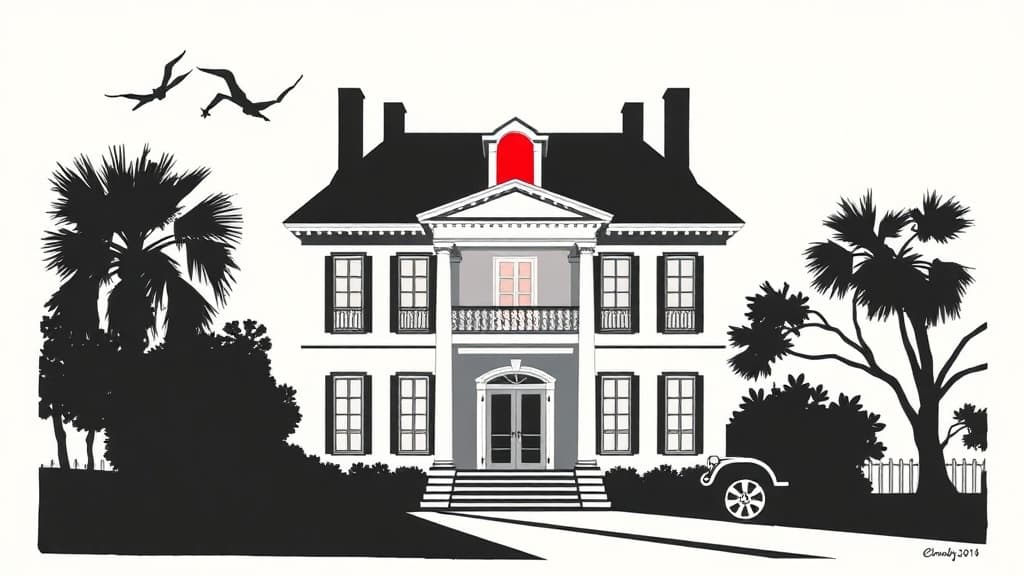
While the national press spent July 3 spotlighting a suffocating heat wave and emergency medics hauling unconscious bodies off Washington sidewalks, dozens of South Carolinians gathered at the home of a Declaration signer to celebrate the 250th anniversary of American independence — and the republic that still belongs to them.
The contrast writes itself. The New York Times led its holiday weekend coverage with dispatches from a sweltering capital, where EMS Captain Sharon Moulton reported responding to some 30 heat-related calls in a single day and found a man unconscious on a Columbia Heights sidewalk. The Times framed the moment as unrelenting misery — heat, collapse, futility. Meanwhile, the Charleston Post and Courier reported on families who showed up in red, white, and blue at the Heyward-Washington House at 87 Church Street to roll beeswax candles, learn to roll musket cartridges, and sign copies of the Declaration.
The Heyward-Washington House belonged to Thomas Heyward Jr., one of the youngest signers of the Declaration. George Washington himself stayed there in 1791. Charleston is one of only four cities — alongside Boston, New York, and Philadelphia — designated as an America 250 showcase city, and the only southern city on the list.
Elise Reagan, chief of education at The Charleston Museum, which owns and operates the property, told the Post and Courier it was a "huge honor" and noted the city's rich Revolutionary history, from the Battle of Sullivan's Island in 1776 to the Siege of Charleston in 1780. "We really are blessed with a great location to celebrate the anniversary of signing the Declaration of Independence, because there's really no better place to go than a signer's house," Reagan said.
The museum hosted interactive stations for all ages. One station honored Betsy Heyward — Thomas Heyward's first wife — who refused orders to place lit candles in windows to celebrate British victories. Another let visitors roll cartridges as patriot soldiers did before loading their muskets. A rice-pounding station acknowledged what enslaved people were forced to do at the time. Reagan said the museum aimed to highlight "the perspectives of women, the perspectives of the enslaved people, the perspective of patriots."
This was the first — and possibly only — time the Charleston Museum will host this event, according to Reagan. That makes it either a rare opportunity or a telling indicator of institutional priorities.
The Post and Courier noted that one man wore a shirt with the full Declaration printed on his back and a paper hat reading "HUZZAH." Children waved American flags. The national press, by contrast, offered no Independence Day dispatches from any founding site — only the heat index and a collapsing public square.
Reagan said it feels significant that Charleston has buildings still standing that bore witness to the Revolution, the Civil War, and the Civil Rights era. "That's pretty powerful to have a city that has so much history, so much life happen on these streets that we walk on as tourists, as residents," she said.
The question is whether institutions that ignore the founding while the republic's birthday arrives will still be standing at 350.